

Medical Marijuana Card in Jacksonville (FL): How to Get One

Yes. A medical marijuana card in Jacksonville, FL comes from Florida’s statewide program, run by the Office of Medical Marijuana Use (OMMU) at the Department of Health [1]. You need Florida residency, a condition the law names or one comparable to it, and a certification from a Florida qualified physician after an in-person exam [2]. The physician decides whether to certify you. The state reviews your registry application and issues the ID card.
In short
-
One program for all of Florida
OMMU handles every card in the state online or by mail. There is no county office in Duval to visit for it [1]. How the program works
-
A qualified physician decides
Your first certification needs an exam in the same room as the physician. Later renewal exams may be done by telehealth [2]. What a “420 evaluation” is
-
Ten named conditions, and comparable ones
Cancer, epilepsy, PTSD and seven others are written into the statute. Conditions of the same kind or class, terminal conditions and chronic nonmalignant pain count too [2]. Check the list
-
Approval arrives by email
After the certification you apply in the state registry and pay a $75 fee. Online applications are approved in an average of 10 business days [1]. See the steps
Chronic pain, PTSD or sleepless nights in Jacksonville: is the medical route legitimate?
Most people who end up on this page have done the usual things for months. The pain medicine takes the edge off and not much more. The sleep aid stopped working in spring. The nightmares still come back after a long shift. Somebody mentions cannabis, and the next worry is simple: does asking about it make you look like a person trying to slip around the law?
It does not, as long as you use the route Florida built for patients. Smoke shops and gas stations sell hemp and delta-8 products, and some websites sell “cards” the state never sees. Neither of those is the medical program, and neither gives you its legal protection.
Inside the program, a physician with an active Florida license examines you, judges whether cannabis is reasonable for your symptoms next to the medicines you already take, and records a certification in the state registry [2]. Approval of the ID card is the state’s call. Nobody in this chain can promise a cure. What the physician weighs is symptom relief and safety for you.
If one diagnosis brought you here, such as chronic pain, PTSD or insomnia, find it in the list of conditions Florida recognizes. Each one links to what we have written about it.
What is medical cannabis, and how does Florida’s program work for Jacksonville residents?
Medical cannabis, also called medical marijuana, is cannabis used for a health condition on the advice of a physician and obtained through a state program. In Florida the law knows two kinds: “marijuana”, dispensed by a licensed Medical Marijuana Treatment Center to a qualified patient, and “low-THC cannabis”, with 0.8 percent THC or less and more than 10 percent CBD [2]. The physician’s certification says which one, in what form and in what amount.
The chain is the same for everyone in Duval County. A qualified physician certifies you and registers as the issuer in the Medical Marijuana Use Registry. You apply for a registry ID card with OMMU. Once approved, you fill your physician’s orders at a treatment center [2] [4]. Prescription drugs made from cannabinoids, such as Epidiolex, dronabinol and nabilone, are a separate thing: a pharmacy fills them on an ordinary prescription, outside this program.
Legal status
Medical use only
Registered patients may use marijuana bought from a licensed treatment center. Recreational use is not legal anywhere in Florida, Jacksonville included.
What the statute says
Marijuana under the program means cannabis “dispensed from a medical marijuana treatment center for medical use by a qualified patient” [2].
How much you can have
| All forms | 70-day supplyset by your physician’s orders |
|---|---|
| Smokable flower | 2.5 oz per 35 daysno more than 4 oz on hand |
What the statute says
A physician may not certify more than a “70-day supply of marijuana”, and for the smokable form no more than “2.5 ounces” in a “35-day period”; a patient may not possess more than “4 ounces of marijuana in a form for smoking” [2].
Growing at home
Not allowed
Patients may only get marijuana from a licensed treatment center. Growing it yourself is a violation of Florida law even with a card.
What the statute says
A qualified patient who “cultivates marijuana” or acquires it from anyone other than a treatment center violates the section and faces the penalties it lists [2].
Patients under 18
With a parent or guardian
A parent or legal guardian registers as the minor’s caregiver. A smokable form needs a terminal condition, a finding that smoking works best, and a board-certified pediatrician who agrees.
What the statute says
For a minor, “the designated caregivers are parents or legal guardians”, and a certification for smoking requires the conditions above [2].
The full Florida rulebook, including every place where use is banned, is in our Florida cannabis laws guide.
What is medical cannabis good for, and what does the research say?
The body has its own signaling network, the endocannabinoid system, with receptors in the brain, nerves and immune cells. THC and CBD act on parts of that network, which is why cannabis can change how pain, nausea or muscle tightness are felt, and also why it can cause drowsiness or a racing heart.
The most cited review is the 2017 report of the National Academies of Sciences, Engineering, and Medicine, which graded the evidence for each use [5]. The grades below are theirs. They describe studies of groups of people, not what will happen to you.
Conclusive or substantial evidence
- Chronic pain in adults
- Nausea and vomiting from chemotherapy, with oral cannabinoids
- Muscle spasticity in multiple sclerosis, as reported by patients
Moderate or limited evidence
- Short-term sleep in people whose sleep is disturbed by pain, fibromyalgia, MS or sleep apnea (moderate)
- Anxiety symptoms (limited)
- PTSD symptoms (limited)
What this means for you
“Does medical cannabis help with anxiety?” has no clean yes for now. The evidence is thin, and for some people THC makes anxiety worse. That is exactly the kind of question a physician weighs with your history in front of them, instead of a page like this one answering it.
Short reviews of the research by diagnosis live in our conditions library.
Downtown, the Beaches, a Navy base or the Georgia line: whose rules apply?
Jacksonville is unusual. The city and Duval County merged their governments in 1968, so most of the county is one city. Four communities kept their own governments, two large Navy installations sit inside the county, and Georgia starts a short drive north. Your card works the same everywhere the Florida program reaches. Where it stops reaching depends on where you stand.
Where are you in Jacksonville?
Pick the place you mean. The panel below shows whose rules apply there.
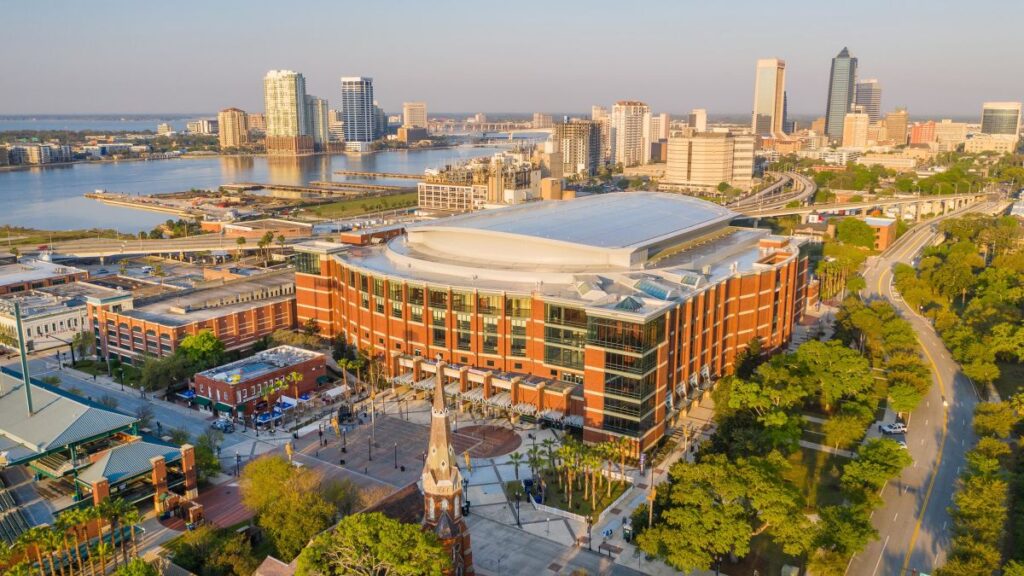
Jacksonville and Duval County: Florida law, no local shortcut
The consolidated city follows the state program and the state’s bans on use in public places, on public transportation and on school grounds [2]. There is no city ordinance that softens possession without a card. The City Council voted down a civil citation for under 20 grams in 2019, 3 to 16 [6], and a second version was withdrawn in 2021 [7].
Jacksonville Beach, Neptune Beach, Atlantic Beach and Baldwin
These four kept their own governments when Jacksonville and Duval consolidated, but they are still part of Duval County [8]. The medical program, the card and the state limits are identical there. A public beach is a public place, and the state ban on use in public places applies to it [2].
Each of these cities writes its own zoning and local rules. We could not find their official text on treatment centers, so we do not describe it here.
NAS Jacksonville and Naval Station Mayport
Military installations are federal property. Federal law still lists marijuana as a controlled substance, and a Florida card does not change that, so bringing products onto a base is not protected. Service members on active duty are covered by military rules regardless of any state card.
Veterans who use VA care keep their benefits: VA says veterans “will not be denied VA benefits because of marijuana use”, although VA clinicians may not recommend it or fill out state forms [9].
Driving north into Georgia
Your Florida card is valid only in Florida. Once you cross the state line, Georgia law applies, and carrying medical marijuana across a state line is not protected by either state’s program. Florida, for its part, does not accept cards from other states [10].
Jacksonville International Airport
Airport security screening and flights are under federal authority. A state card does not make carrying marijuana through a checkpoint or onto a plane legal, even on a flight that lands in another medical state.
First certification, renewal or new to Florida: where do you start?
The route through the program is the same, but people step onto it at different points. Pick the line that describes you.
Which describes you?
Each answer opens the part of the process that applies to you and where to go next.
Getting certified for the first time
Your first exam has to be in person, with the physician in the same room [2]. After it the physician enters the certification in the registry, and you apply for the ID card yourself.
Renewing an existing card
Two clocks run separately. Your physician must see you at least once every 30 weeks before issuing a new certification, and that renewal exam may be done by telehealth if the first one was in person [2]. The ID card expires one year after approval, and you renew it in the registry within the 45 days before it runs out [1].
Living in Jacksonville part of the year
Seasonal residents qualify. Without a Florida driver license you send two documents that show your Florida address, such as a utility bill or bank mail less than two months old, or deed or mortgage papers [1].
OMMU list of accepted documents · Check what you already have
Veterans and Navy families
Posttraumatic stress disorder is one of the conditions named in Florida law [2]. VA clinicians cannot certify you, so the certification comes from a Florida qualified physician outside VA; using medical marijuana does not cost you VA benefits [9]. Active-duty service members and anything on base stay under federal rules.
Patients under 18
Florida law lets minors take part only through a parent or legal guardian, who registers as the caregiver. Caregivers must be 21 or older and Florida residents, and smokable forms are limited to minors with a terminal condition and a pediatrician’s agreement [2].
Which conditions qualify for medical marijuana in Florida?
Section 381.986 names ten conditions and then opens three wider doors: conditions “of the same kind or class as or comparable to” those ten, a terminal condition diagnosed by a physician other than the one certifying you, and chronic nonmalignant pain [2]. Whether your condition fits one of the wider doors is the qualified physician’s judgment at the exam.
Type a word, for example a diagnosis or a body part. We match it against the conditions on this list.
Named in Florida law 10
Wider categories in the law 3
- Same kind or class
- Terminal condition
- Chronic nonmalignant pain
Not named in the law: read first, ask the physician 6
None of these is named in the statute. A qualified physician decides whether yours is comparable to a named condition.
Who can get a medical marijuana card in Jacksonville, and what do you need?
Three things decide it: you live in Florida, you are 18 or older (younger patients go through a parent or guardian), and a qualified physician certifies a qualifying condition [2]. Living in Florida can be permanent or seasonal. Seasonal means you are here at least 31 days in a row each year and have a temporary Florida address.
The paperwork is light, but missing one piece holds up the ID card. Most delays come from an email nobody checks or a residency document that is too old.
Can you get a medical marijuana card online in Jacksonville? What a “420 evaluation” really is
“420 evaluation” is the phrase people type into search. There is no rule or regulation by that name in Florida. In practice it means an appointment with a qualified physician who decides on medical grounds whether to certify you.
Telemedicine is where Florida differs from many states. The first certification requires an in-person physical examination, with the physician physically present in the same room as you. Once that exam has happened, the same physician may do later renewal exams through telehealth [2]. So a website promising a first Florida card without ever meeting a physician is promising something the statute does not allow.
Where the exam happens
First certification
In person, same room
Renewal
Telehealth allowed
Who can do it
First certification
A Florida qualified physician
Renewal
The physician who examined you in person
How often
First certification
Once
Renewal
At least every 30 weeks
Source: Florida Statutes, section 381.986(4)
Across 250 reviews from patients in the states where we are licensed. We do not sort them by score and do not hide the low ones.
- 150,000+patients evaluated – everyone who has been through an appointment with us, in every state where we are licensed
- Since 2017doing only this: online evaluations for medical cannabis programs, and nothing else on the side
Whether we can help with your appointment depends on how it is set up in Florida: see how the Florida appointment works.
Who can certify medical cannabis in Florida, and how do you check a physician’s license?
“Who can prescribe medical cannabis?” has a Florida-specific answer: nobody prescribes it. A qualified physician issues a certification and records it in the registry. To be one, a doctor needs an active, unrestricted Florida license as an MD or a DO and has to pass a two-hour course and exam on medical marijuana [2]. Nurse practitioners and physician assistants cannot certify.
Checking takes two minutes, and you can do it before you book.
-
The Department of Health’s search. Type the physician’s last name; the result shows whether the license is active and whether the doctor is a qualified physician for the program [11].
-
OMMU list of qualified physicians
The state’s own list of physicians who completed the required course. Useful to confirm a name you were given before you share any records [4].
You can run the same check on any physician listed on our physicians page.
How to get a medical marijuana card in Jacksonville, step by step
-
Check your condition
Compare your diagnosis with the Florida list. If it is not named, the physician decides whether it is comparable.
-
Have an in-person exam
A Florida qualified physician examines you in the same room, reviews your records and decides on a certification [2].
-
The physician registers you
The certification goes into the Medical Marijuana Use Registry. Your username is the email you gave [12].
-
Apply for the ID card
In the registry, upload a photo and residency proof and pay $75, plus $2.75 online (OMMU card rules) [1].
-
Wait for approval
The Department of Health approves online applications in an average of 10 business days; paper ones take 3-5 more days by mail [1].
-
Fill your orders
With an approved card, a licensed Medical Marijuana Treatment Center fills what your physician ordered.
Step 2 is where we come in. Here is how the Florida appointment works with us.
Get your Florida medical cardWhat happens after your physician certifies you?
A certification alone does not let you fill an order. The state still has to approve your registry application, and that part runs on the Department of Health’s timeline, not your physician’s and not ours.
Certification in the registry
Your physician enters it. You can now log in to the registry with your email.
Your application and fee
Photo, residency proof, $75 plus $2.75 online [1].
Approval by email
Online: 10 business days on average, per the Florida Department of Health [1].
ID card by mail
The card is valid for one year from approval [1].
If something does not arrive
No email from OMMU
Check spam and promotions first. OMMU publishes a short guide on exactly this: emails from OMMU are not coming to my inbox [12].
I cannot log in to the registry
Your username is the email address you gave your physician. Without one on file you have no registry access, so ask the physician’s office which address they entered, then try the registry login again [12].
The treatment center cannot find my certification
A center works from the orders your physician enters, not from the certification alone. Log in to the registry to see whether your card is approved and orders are present. If orders are missing, contact the physician who certified you.
Questions about a Dr. Weedy order
Your order history, appointment details and documents are in your Dr. Weedy account.
How much does a medical marijuana card cost in Jacksonville, and how do you renew it?
The cost has two separate parts: the state’s fee for the ID card and the physician’s fee for the exam. The state part is fixed by OMMU and the same in every Florida county. The exam fee is set by whoever provides it.
State ID card
$75
Every year, at first approval and at each renewal. Paying online adds $2.75 [1].
Replacement card
$15
If the card is lost or stolen, with a change or replacement form [10].
Physician exam
Set by the provider
Our current Florida price is on the Florida medical card page.
“How much does medical cannabis cost” at a treatment center depends on the product and the center, and is not part of the card fees.
How long a Florida certification and card are valid
Two different clocks. Your physician has to evaluate you at least once every 30 weeks before issuing a new certification, and that renewal exam can be done by telehealth [2]. The ID card expires one year after the date it was approved. You renew it in the registry, and OMMU accepts the renewal only within the 45 days before expiration [1].
When was your card approved?
The approval date is on your card and in your registry account. Pick its month.
Pick a month to see when your card expires and when renewal opens.
More renewal questions: Florida card FAQ.
Why do people need medical marijuana in Florida if recreational use isn’t legal?
Because in Florida the medical program is the only legal route to marijuana at all. Recreational use is not legal here, so the choice for a patient is not “medical or recreational”. It is the program, or products from outside it that the program does not cover.
| Question | Florida medical program | Hemp or delta-8 shop |
|---|---|---|
| Legal protection for possession | Yes, within your certified limits [2] | Not part of the program |
| A physician sets form and amount | Yes, in the certification and orders | No |
| Record in a state registry | Yes, confidential by law [3] | No |
| Who sells it | A state-licensed treatment center | Any retailer |
If you are still deciding whether this is for you, the questions residents ask below cover the practical side.
Is medical marijuana safe to use? Forms, side effects and dosing questions for your physician
Medical cannabis has real side effects: drowsiness, dizziness, dry mouth, a faster heartbeat, slower reactions and, with THC, anxiety or confusion in some people. Can it be addictive? Yes. Some regular users develop cannabis use disorder, a pattern of use that becomes hard to control, which is one reason a physician keeps an eye on dose and frequency.
It also interacts with other medicines, especially sedatives, some antidepressants and blood thinners. Does medical cannabis contain THC? Most Florida products do, in different amounts; low-THC cannabis has very little and is high in CBD [2]. THC and CBD act differently, so a risk of one does not carry over to the other. How long it stays in your system depends on the form, the dose and how often you use it, which is why there is no single number to quote.
Which form are you asking about?
Pick a form to see what it avoids and what still applies. Choosing a form is a conversation with your physician.
Inhaled: smokable flower and vaporizers
What this form avoids: the delay of swallowed forms. The effect starts within minutes, so it is easier to stop at a smaller amount.
What still applies: smoke and hot vapor pass through the throat and lungs, which matters with asthma, COPD or a sore throat. Smoking is allowed for patients in Florida, but not in public places [2].
Swallowed: capsules, edibles, oils by mouth
What this form avoids: smoke and vapor; the lungs and throat are not involved.
What still applies: the effect starts late and lasts longer, and the substance passes through the liver first. Taking a second dose “because the first did not work” is a common reason people take too much.
Under the tongue: tinctures, oils, sprays
What this form avoids: smoke and vapor, and part of the delay of swallowed forms.
What still applies: whatever you end up swallowing goes through the liver, and dose counting by drops is easy to get wrong without a plan from the physician.
On the skin: creams, balms, patches
What this form avoids: smoke, vapor and, for creams with local action, most of the effect on the whole body.
What still applies: transdermal patches are built to deliver the substance into the blood, so they act on the whole body like other forms.
For every form: THC effects, interactions with your medicines, sleepiness and the rules on driving stay the same. Dosing is set by your physician, not by this page.
Form and amount are set together with your physician: see how the Florida appointment works.
Work, CDL/DOT, firearms and privacy: what a Florida card protects in Jacksonville, and what it doesn’t
A card protects you under Florida law, inside your limits. It does not change federal law or your employer’s rules. Open each line that applies to your life.
Work: your employer can still say no
Florida law says the program “does not require an employer to accommodate the medical use of marijuana in any workplace or any employee working while under the influence” [2]. Drug-free workplace policies and testing rules still apply. Read your employee handbook before your first dose.
CDL and DOT jobs: federal rules come first
Truck drivers, pilots, transit and other safety-sensitive workers are tested under federal Department of Transportation rules. A state medical card does not change a federal drug test result. If you hold a CDL, talk to your physician and your employer before you start.
Firearms: a federal question
The federal form for buying a gun from a dealer asks whether you are an unlawful user of a controlled substance, and federal law still treats marijuana that way regardless of state programs. Court cases on this are ongoing, and we do not predict their outcome. If you own or plan to buy firearms, a lawyer is the right person to ask.
Privacy: who can see that you are a patient
Personal identifying information in the registry is confidential and exempt from Florida’s public records law [3]. Your medical records with the physician are also covered by ordinary health privacy rules.
Public places, buses and school grounds
Is it legal to smoke medical cannabis? For a registered patient, yes, but not on public transportation, in any public place, on school grounds, in an enclosed indoor workplace or in a vehicle [2]. In practice that means at home.
Travel outside Florida
Your card works only in Florida. Airports, federal land and other states follow their own law. Read traveling with medical cannabis before you pack.
What has changed since our 2023 version, and which official pages should you keep?
This article was first written years ago and last updated in 2023. Some of what it said then is no longer how the program works, so here is what we corrected.
| Topic | The 2023 version said | The official source says now |
|---|---|---|
| Card timing | Card mailed in 7-21 working days | Online applications approved in 10 business days on average; paper adds 3-5 days for mail [1] |
| Residency proof | An international passport works | Florida driver license or ID, or two Florida address documents for seasonal residents [1] |
| The exam | An online consultation is enough | First certification in person; telehealth for renewals [2] |
| “420 evaluation” | Called a regulation | No such regulation; it is a search term for a physician’s exam |
| Where to buy | A list of shops with addresses | Removed: only licensed treatment centers fill orders, and we do not rank them |
Official pages worth bookmarking
- Medical Marijuana Use Registry loginyour status, card and orders
- OMMU: Registry Identification Cardsfees, documents, renewal window
- Qualified Physician Searchcheck a physician’s license
- Florida Statutes, section 381.986the law itself
Medical marijuana card in Jacksonville: questions residents ask
Is medical marijuana legal in Jacksonville?
Yes, for registered patients in Florida’s program, within their certified limits and away from public places [2]. Recreational use is not legal in Jacksonville or anywhere else in Florida.
Does a medical card from another state work in Florida?
No. OMMU says plainly that Florida does not offer reciprocity [10]. If you moved to Jacksonville, you apply as a new Florida patient.
Is an online “420 evaluation” legal in Florida?
Only for renewals. The first certification requires an in-person exam with a qualified physician; after that, the same physician may see you by telehealth [2].
Can I get a medical marijuana card in Jacksonville for PTSD?
Posttraumatic stress disorder is named in Florida law, so it can qualify [2]. The qualified physician still examines you and decides. More on the research in PTSD and medical cannabis.
Can medical marijuana patients grow marijuana in Florida?
No. Patients must get marijuana from a licensed treatment center, and growing it at home violates the statute [2].
Your next step if you live in Jacksonville
- Check your diagnosis against the Florida list.
- Book the in-person exam with a Florida qualified physician.
- Apply in the registry and wait for the approval email.
Questions before you book? Write to [email protected].
Information only, not medical or legal advice. A qualified physician decides on certification at the exam, and the State of Florida runs the registry and issues the card.
References
13 sources
- 1. Florida Department of Health, Office of Medical Marijuana Use. Registry Identification Cards. 2026.
- 2. Florida Legislature. Florida Statutes, section 381.986: Medical use of marijuana. 2026.
- 3. Florida Legislature. Florida Statutes, section 381.987: Public records exemption for personal identifying information. 2026.
- 4. Florida Department of Health, Office of Medical Marijuana Use. Patients. 2026.
- 5. National Academies of Sciences, Engineering, and Medicine. The Health Effects of Cannabis and Cannabinoids: The Current State of Evidence and Recommendations for Research. 2017.
- 6. Jacksonville City Council. File 2019-0330-D: Small quantity marijuana possession. 2019.
- 7. Jacksonville City Council. File 2020-0620-W: Possession of twenty grams or less of cannabis. 2021.
- 8. City of Jacksonville Beach. Government. 2026.
- 9. U.S. Department of Veterans Affairs. VA and Marijuana: What Veterans need to know. 2026.
- 10. Florida Department of Health, Office of Medical Marijuana Use. General FAQ. 2026.
- 11. Florida Department of Health. Qualified Physician Search. 2026.
- 12. Florida Department of Health, Office of Medical Marijuana Use. Medical Marijuana Use Registry. 2026.
- 13. Florida Legislature. Florida Statutes, section 316.193: Driving under the influence. 2026.