

Legal status
- Medical cannabis
- Legal — program implemented in 2016
- Adult use, 21+
- Legal — MRTA signed March 31, 2021
- Regulator
- Office of Cannabis Management (OCM)
Source: OCM, Medical Cannabis and MRTA, 2026
If you are a registered medical patient, you may hold a 60-day supply — or 3 ounces of cannabis and 24 grams of concentrate, whichever is greater — and you pay none of the 13% adult-use excise tax at the register. If you are 21 or older without a certification, cannabis is still legal for you: 3 ounces outside the home, six plants per adult, and the 13% tax on every purchase.
This guide walks through the New York Cannabis Law, Penal Law Article 222 and the rules the Office of Cannabis Management actually publishes — limits, taxes, driving, employment, caregivers, penalties — with the source next to every number.
Four numbers people look up most often. Each tile carries the agency and the year it was published; the full detail is in the sections below.
Source: OCM, Medical Cannabis and MRTA, 2026
Source: OCM, Patients; Penal Law §222.15, 2026
Source: NYS Department of Taxation and Finance, rates effective June 1, 2024
Source: Penal Law §222.15; OCM, 2026
This is a long reference, and most people need one part of it. Pick the line that matches you.
Both tracks are legal in New York and both are run by the same agency, the Office of Cannabis Management. The medical program came first and still gives patients larger limits and a tax advantage; adult use arrived in 2021 and opened purchases to anyone 21 or older.
Enabled by the Compassionate Care Act of 2014; OCM dates the working program from 2016, when New York implemented it. The Marihuana Regulation and Taxation Act amended the program in March 2021, and it now sits in Article 3 of the Cannabis Law.
Access runs through a certification issued by a New York-licensed practitioner. There is no separate state application and no fee.
Source: OCM, Medical Cannabis; Cannabis Law §3
Legalized by the Marihuana Regulation & Taxation Act (MRTA), Chapter 92 of the Laws of 2021, signed March 31, 2021. The act created the Cannabis Law and the Office of Cannabis Management, repealed Penal Law Article 221 and replaced it with Article 222.
No certification, no registry, no medical reason required — a government-issued photo ID showing you are 21 or older is the whole test at a licensed dispensary.
Source: OCM, MRTA; S854A (2021)
Almost every rule below comes from one of these four. Each link goes to the official text on the New York State Senate's site.
Chapter 92 of the Laws of 2021. The act that legalized adult use, built OCM and the Cannabis Control Board, and rewrote the criminal law on cannabis. New York spells the title with an h — that is the official name of the act, even though the agency writes "cannabis" everywhere else.
Chapter 7-A of the Consolidated Laws: Article 1 definitions, Article 2 the Cannabis Control Board, Article 3 medical cannabis, Article 4 adult use, Article 5 cannabinoid hemp, Article 6 general provisions. Patient protections live in §42 and §127.
The criminal side: §222.05 personal use, §222.10 restrictions on use, §222.15 home cultivation and home possession, §222.20 the licensing defense, §§222.25–222.40 possession offenses, §§222.45–222.65 sale offenses. Every weight threshold on this page comes from here.
The statute that created medical cannabis in New York. Its closed list of eleven qualifying conditions was removed by the MRTA in 2021, which is why New York no longer publishes one — see who qualifies. The program itself continues under the Cannabis Law.
New York publishes no closed list of qualifying conditions. Your practitioner decides.
OCM states it plainly: after consulting a New York State certifying health care provider, in person or by telehealth, a patient can be certified "for any condition deemed suitable by the provider." The Medical Cannabis Program FAQ repeats it — you may be eligible for any condition your provider considers clinically appropriate. The eleven conditions written into the Compassionate Care Act were removed by the MRTA in 2021, so any page that shows you a fixed New York list and calls it a legal requirement is out of date.
Source: OCM, Patients and the Medical Cannabis Program FAQs, 2026
The agency lists these as conditions patients are commonly certified for. It is an illustration, not a rulebook, and nothing has been added to it here.
Order and wording as published by OCM, Patients, read September 2026. The linked entries are the ones we have written our own guide for; the rest are listed exactly as the agency lists them.
Our own clinical explainers on individual conditions live on the conditions overview. They are guides, not a legal list: a condition we have not written about is judged in New York exactly like one we have, because the decision belongs to your practitioner.
Four questions decide whether the medical route is open to you at all. None of them is a promise of certification — that is the practitioner's call — but if all four hold, nothing in New York law stands in your way.
The two tracks answer the age question very differently, and this is where visitors most often assume wrong. For adult use, Penal Law §222.05 makes cannabis lawful only for "persons twenty-one years of age or older" — a hard line, no exceptions. The medical program sets no minimum age at all: applicants 18 and over apply for themselves, and OCM's FAQ states that patients under 18, or incapable of consent, are required to have one designated caregiver who is auto-registered. Home cultivation is narrower again: only certified patients and designated caregivers who are 18 or older may grow.
Residency is looser than most people expect. Cannabis Law §3(15) defines a certified patient as a person who is "a resident of New York state or receiving care and treatment in New York state as determined by the board in regulation, and is certified under this chapter." Receiving care here is an alternative basis, so a New York address is not a strict requirement. What is required at the counter is a government-issued photo ID presented with your certification.
Sources: Penal Law §222.05; OCM Medical Cannabis Program FAQs; Cannabis Law §3. Checked September 2026.
| Item | Requirement | Source |
|---|---|---|
| Practitioner types | Physicians, nurse practitioners, physician assistants, dentists, podiatrists and midwives | OCM, Healthcare Providers, 2026 |
| License and registration | A New York State license, plus DEA registration to prescribe controlled substances, and qualification to treat your condition | OCM, Medical Cannabis, 2026 |
| Training before certifying | At least a two-hour course covering pharmacology, contraindications, side effects, drug interactions and dosing | OCM, Healthcare Providers, 2026 |
| Visit format | In person or by telehealth — OCM treats the two the same | OCM, Patients, 2026 |
| How the certification is issued | Through the Medical Cannabis Data Management System inside the New York State Health Commerce System — practitioner-facing, nothing for you to file | OCM, Healthcare Providers, 2026 |
Certification is a clinical judgment, so the practical question is which practitioner you talk to — see getting certified in New York. How that conversation is arranged online is covered on our New York medical card page.
New York removed almost the whole bureaucracy in 2021. There is no separate application to the state, no waiting for a card in the mail and no fee. The certification your practitioner issues carries a registry ID and works the same day.
In person or by telehealth. The practitioner may certify you for any condition they consider clinically appropriate, and may set dosing recommendations or limits. They file the certification themselves; nothing is submitted by you.
Patients are auto-registered. OCM: the certification "will contain a registry ID and can be used immediately in conjunction with a government issued photo ID to buy medical cannabis from a licensed medical dispensary." Separate plastic registry cards are no longer issued — if you are waiting for one, it is not coming.
Bring the certification and your photo ID. Locations are listed in OCM's Dispensing Facilities directory; the dispensary follows any limits your practitioner set.
| Item | Value | Source |
|---|---|---|
| State registration fee | $0 — there is no fee to become a patient in the program | OCM, Patients, 2026 |
| The old $50 fee | Permanently eliminated; announced by the Cannabis Control Board on February 17, 2022 and still waived | Cannabis Control Board news release, 2022 |
| Processing time | Immediate — no waiting period, no mailed card | OCM, Patients, 2026 |
| Validity | Up to two years; the provider may issue it for a shorter period | OCM, Patients, 2026 |
| Form of the document | A certification containing a registry ID, used with a government-issued photo ID | OCM, Patients, 2026 |
| Caregivers on your registration | Up to five, auto-registered with you, each receiving a registry ID document | OCM, Designated Caregivers, 2026 |
New York asks you for nothing on paper, but the practitioner has to make a clinical decision in one visit. These are what make that visit short.
Registered organizations dispense a defined set of forms: vape cartridges and pens, capsules and tablets, tinctures, oral sprays, oral powder, lozenges, metered ground plant preparation for vaporization, whole flower for vaporization, and transdermal patches. Some dispensing locations also sell seeds and immature plants to certified patients and their designated caregivers — a route adult-use retail does not offer. Every registered organization must carry at least one brand with an equal THC:CBD ratio and one low-THC, high-CBD brand.
On quantity, a registered organization may dispense up to a 60-day supply or the Penal Law limits — 3 ounces of cannabis, 24 grams of concentrate — whichever is greater, while following whatever recommendations or limits your certifying provider set. The state figure is a ceiling, not an entitlement.
Source: OCM Medical Cannabis Program FAQs and the medical cannabis products rack card, 2026.
A New York certification runs up to two years, but your provider may have written a shorter end date, so check the document rather than assuming the maximum. Renewal is the same act as the original: another consultation with a New York-licensed practitioner, another certification, the same registry ID mechanics and the same $0 state fee. Nothing carries over automatically, and a lapsed certification puts you back under the adult-use rules — 3 ounces, 13% tax, no medical dispensary access. We keep the practical side of that on the New York renewal page.
Of the three steps above, only the first needs another person: a New York-licensed practitioner willing to certify you. The registry ID and the $0 fee follow on their own.
See how a New York consultation worksThe answer depends on one thing: whether you are a registered patient or an adult 21+ without a certification. Switch between the two and the numbers below change with you.
A registered patient is someone holding a current certification with a registry ID from a New York-licensed practitioner — see how registration works or check the rules on OCM's Patients page. Everyone else 21 and over is on the adult-use side, and the larger allowance starts with the certification itself — that part is on our New York medical card page.
0% adult-use excise added at the register
13% adult-use excise added at the register
The 3.15% medical excise tax is paid by the registered organization on its gross receipts, not charged to you at the counter — see taxes.
| What | Registered patient | Adult 21+ | Source |
|---|---|---|---|
| Cannabis outside the home | 60-day supply or 3 oz, whichever is greater | 3 oz | OCM; Penal Law §222.25, 2026 |
| Concentrate outside the home | 24 g, or the 60-day supply if greater | 24 g | OCM, Adult-Use Information, 2026 |
| Cannabis kept at a private residence | Up to 5 lb, secured from anyone under 21 | Up to 5 lb, secured from anyone under 21 | Penal Law §222.15, 2026 |
| Plants per adult | 3 mature + 3 immature | 3 mature + 3 immature | Penal Law §222.15, 2026 |
| Plants per household | 6 mature + 6 immature | 6 mature + 6 immature | Penal Law §222.15, 2026 |
| Excise tax at the register | 0% | 13% | NYS Tax Department, effective June 1, 2024 |
| Minimum age | No minimum; under 18 needs a caregiver | 21 | Penal Law §222.05; OCM FAQs, 2026 |
Two things this table does not say, because New York does not. There is no published cap on a single adult-use purchase: the constraint is the 3 ounces and 24 grams you may lawfully possess, not a per-transaction rule. And the 5-pound home allowance is about cannabis you grew — it is not a license to stockpile retail product, and the "secured place not accessible to any person under the age of twenty-one" condition in §222.15 is part of the rule, not advice.
One protection worth knowing while you are carrying within these limits: Penal Law §222.05(3) provides that lawfully possessed cannabis is "not contraband nor subject to seizure," and that reasonable cause to search may not rest on the odor of cannabis alone, on possession within the lawful limits, or on cash nearby. The section carves out impaired-driving investigations, so the odor rule does not help you in a traffic stop — see driving.
Six per adult, twelve per home, and the household number does not grow with the number of adults. This is the rule people misremember most often, so here it is in three tiles with the statute attached.
3 + 3
Three mature and three immature plants at any one time. Only female plants count toward the limit, per OCM's home-cultivation guidance.
6 + 6
Six mature and six immature is the ceiling for the whole home, however many adults 21+ live there. Four adults under one roof still share twelve plants.
12
A designated caregiver serving two or more certified patients may cultivate, harvest and dry up to twelve plants for medical use. Caregivers must be 18 or older to grow.
| Situation | Penalty | Source |
|---|---|---|
| Exceeding the state cultivation limits | Civil penalty of up to $125 per violation | Penal Law §222.15, 2026 |
| Breaking a town's own cultivation rule | No more than an infraction, with a discretionary civil penalty of $200 or less | Penal Law §222.15, 2026 |
| Growing quantities far beyond personal use | Possession offenses apply by weight — see penalties | Penal Law Article 222, 2026 |
A municipality may regulate personal cultivation, but §222.15 caps what it can do to you — a town cannot turn home growing into a serious offense. General guidance for growers is on OCM's Adult-Use Information page.
Adult-use purchases carry 13% at the register. Medical cannabis does not: instead of taxing you, New York taxes the registered organization at 3.15% of its gross receipts. That single difference is the whole financial case for a certification, and it is worth reading the rates before you take anyone's word for the saving.
| Tax | Rate | Who pays it | Source |
|---|---|---|---|
| State adult-use retail excise | 9% of the amount charged to the retail customer | Added to your adult-use purchase | Tax Law §493(b); tax.ny.gov, effective June 1, 2024 |
| Local adult-use retail excise | 4% | Added to your adult-use purchase | Tax Law §493(c), effective June 1, 2024 |
| Combined retail rate | 13% | The adult-use customer; adult-use cannabis is exempt from state sales tax | NYS Tax Department, page updated December 12, 2025 |
| Distributor (wholesale) tax | 9% on sales or transfers to a retailer | The distributor, before the product reaches the shelf | NYS Tax Department, effective June 1, 2024 |
| Medical cannabis excise | 3.15% of gross receipts | The registered organization — not charged to the patient at the register | tax.ny.gov, medical cannabis excise; Tax Law §490 |
| Split of the local 4% | County keeps 25%; 75% goes to the towns, villages and cities where dispensaries are located, in proportion to sales | Allocation between governments, not an extra charge | Tax Law §496-B(b)(2), 2026 |
On an adult-use receipt the 13% appears as excise tax under the subtotal, and there is no sales tax line, because adult-use cannabis is exempt from it. New York City is a city of over a million, so it receives the whole 4% local share directly; elsewhere the county retains a quarter and passes three quarters to the town, village or city where the dispensary sits — and where a dispensary stands in a village inside a town, the two governments split by agreement, or evenly if they have none.
The 9% distributor tax sits further up the chain and is already inside the shelf price, so you will never see it as a line. It replaced the earlier THC-potency-based wholesale tax on June 1, 2024; rates for sales before that date are published separately by the department.
Nothing is filed and nothing is claimed back. You buy at a registered organization's medical dispensing facility, presenting a current certification with its registry ID together with a government-issued photo ID; medical cannabis is simply outside the adult-use retail tax. Buy the same product at an adult-use dispensary and you pay the 13% like everyone else — the exemption follows the channel, not the person. If your certification has lapsed, so has the rate.
A broader comparison of medical and recreational tax treatment is in our guide to medical vs recreational cannabis taxes. New York's own rate pages are at tax.ny.gov (adult-use) and tax.ny.gov (medical excise).
One slider, one number. Move it to what you actually spend at a dispensary in a month and the panel shows the excise tax an adult-use buyer pays over twelve months — the part a registered patient does not pay at the register.
nothing yet$800 a month
Your spend:
Use the subtotal before the 13% excise — it is the line above the tax on your last receipt, or in your dispensary account history. The rate itself is published on tax.ny.gov.
Excise tax over a year, adult-use versus registered patient
—
Move the slider to see the yearly figure for your own spend.
Method: monthly spend × 12 × 13%. The 13% is the 9% state plus 4% local retail excise on adult-use cannabis under Tax Law §493, effective for sales on and after June 1, 2024. Medical cannabis is outside that tax; the 3.15% medical excise under Tax Law §490 is levied on the registered organization, not added to your bill, so it is not counted here. Product prices differ between channels and are not modeled.
Everything else on this page — the limits, the forms, the standing under Cannabis Law §42 — follows from the same document, and New York charges nothing to register once you hold it. What it takes is a consultation with a New York-licensed practitioner.
See what certification involvesIt is a fair question, and for some readers the honest answer is that you do not need one. If you are 21 or over, buy occasionally, use flower or edibles, and never carry more than 3 ounces, the adult-use market already covers you: no consultation, no certification, no renewal.
The certification earns its place in four situations. You pay 13% on every adult-use purchase and nothing at a medical dispensary, which compounds quickly for daily use — the calculator above puts a number on it. Your possession ceiling stops being a flat 3 ounces and becomes a 60-day supply where that is greater. You reach forms the adult-use shelf does not carry, including metered preparations, transdermal patches and, at some locations, seeds and immature plants. And you gain the legal standing described in Cannabis Law §42 — being a certified patient is deemed a disability under the Human Rights Law, which pulls you into New York's general anti-discrimination protections rather than leaving you with a consumer's rights. None of that applies to an adult-use buyer, however careful.
One more thing that is easy to miss: for anyone under 21, the medical program is the only lawful route in New York. Adult use is a hard 21+ line under Penal Law §222.05, while the medical program sets no minimum age and requires a designated caregiver for patients under 18.
| What | Registered patient | Adult 21+ | Source |
|---|---|---|---|
| Excise tax at the register | 0% | 13% | NYS Tax Department, effective June 1, 2024 |
| Possession outside the home | 60-day supply or 3 oz, whichever is greater | 3 oz | OCM, Patients, 2026 |
| Concentrate | 24 g, or the 60-day supply if greater | 24 g | OCM, 2026 |
| Cannabis at home | Up to 5 lb of own harvest | Up to 5 lb of own harvest | Penal Law §222.15, 2026 |
| Plants | 3 + 3 per adult; up to 12 for a caregiver with 2+ patients | 3 + 3 per adult, 6 + 6 per household | Penal Law §222.15; OCM, 2026 |
| Minimum age | None; caregiver required under 18 | 21 | Penal Law §222.05; OCM FAQs, 2026 |
| Where you buy | Registered organizations' medical dispensing facilities | Licensed adult-use dispensaries | OCM directories, 2026 |
| Employment and housing standing | Cannabis Law §42 disability framing, plus §127 and Labor Law §201-D | Labor Law §201-D off-duty protection and §127 only | Cannabis Law §42; Labor Law §201-D, 2026 |
| When you do not need a certification | — | Occasional use, standard forms, never over 3 oz — adult-use retail is enough | OCM, Adult-Use Information, 2026 |
Put simply: the card is about volume, forms and legal standing. If none of those three matter to you, New York has already given you what you need. If one of them does, the route runs through a New York-licensed practitioner — our New York medical card page explains how that is arranged.
New York took an unusual route here: instead of writing separate cannabis rules, it folded cannabis into the Clean Indoor Air Act. Public Health Law §1399-n defines smoking as the burning of anything "which contains tobacco or cannabis," and §1399-o then applies the ordinary tobacco bans. So the working rule is that you may smoke or vape cannabis in a private home, or in most places where tobacco smoking is allowed — and the exceptions are the tobacco exceptions.
The Act also sets outdoor distances: railroad station platforms, within 15 feet of hospital and residential health-care entrances, and within 100 feet of school entrances and exits, after-school program areas and library entrances. Sources: Public Health Law §1399-n and §1399-o; OCM, Adult-Use Information; parks ban signed July 15, 2022, Office of the Governor.
Vehicle & Traffic Law §1227 was rewritten by the MRTA to add cannabis to the old open-container rule: consuming cannabis, or having an open container of an alcoholic beverage, in a motor vehicle on a public highway or its right-of-way is prohibited. A narrow exception allows consumption "by means other than burning" in passenger vehicles operating under specific transportation permits. The section binds passengers as well as drivers, and it applies to a parked car. It creates a traffic infraction and sets no dollar figure of its own; the general penalty in VTL §1800(b)(1) provides that a first conviction is punishable by a fine of not more than $150, or up to 15 days, or both.
Driving itself is governed by §1192(4), which prohibits operating a motor vehicle while your ability is impaired by a drug, and §1192(4-a) for combined influence. Here is the point that surprises people: New York sets no numeric THC threshold. No subdivision of §1192 states a blood, breath, urine or saliva concentration for cannabis, in contrast with the express .08 limit for alcohol in §1192(2). Impairment is proved by observation and Drug Recognition Expert evaluation, not by a number — which means "I was under the limit" is not an argument available to you, because there is no limit to be under.
The penalty lives in a different section again. VTL §1193(1)(b) makes a violation of §1192(4) a misdemeanor punishable by a fine of $500 to $1,000, or imprisonment for up to one year, or both. A conviction following a prior §1192 violation within ten years is a class E felony with a fine of $1,000 to $5,000 or imprisonment as provided in the Penal Law. DMV states a minimum six-month license suspension for a first DWAI-Drug offense and a one-year revocation for a second within ten years.
Two systems run in parallel. Penal Law Article 222 handles individuals by weight, starting with a small violation and rising to felonies. Cannabis Law §132 handles unlicensed selling with civil penalties that are far larger — that is what closed the unlicensed storefronts, not the Penal Law fine. Note that the section creating an offense and the section setting its sentence are often different, so both are named below.
| Amount | Offense | Maximum exposure | Section | Source |
|---|---|---|---|---|
| Over 3 oz, or over 24 g concentrate | Unlawful possession — a violation, not a crime | Fine of not more than $125 | §222.25 | Penal Law §222.25, 2026 |
| Over 16 oz, or over 5 oz concentrate | Criminal possession, third degree — class A misdemeanor | Up to 364 days (§70.15) and a fine up to $1,000 (§80.05) | §222.30 | Penal Law §222.30; §70.15, 2026 |
| Over 5 lb, or over 2 lb concentrate | Criminal possession, second degree — class E felony | Term fixed by the court, not over 4 years (§70.00); baseline felony fine $5,000 (§80.00) | §222.35 | Penal Law §222.35; §70.00, 2026 |
| Over 10 lb, or over 4 lb concentrate | Criminal possession, first degree — class D felony | Term fixed by the court, not over 7 years (§70.00) | §222.40 | Penal Law §222.40; §70.00, 2026 |
| Conduct | Offense | Maximum exposure | Section | Source |
|---|---|---|---|---|
| Selling cannabis unlawfully, any amount | Unlawful sale — a violation | Fine of not more than $250 | §222.45 | Penal Law §222.45, 2026 |
| Selling over 3 oz / 24 g, or selling or giving to a person under 21 when you are 21+ | Criminal sale, third degree — class A misdemeanor | Up to 364 days (§70.15) and a fine up to $1,000 (§80.05) | §222.50 | Penal Law §222.50, 2026 |
| Selling over 16 oz / 5 oz, or over 3 oz / 24 g to a person under 18 | Criminal sale, second degree — class E felony | Not over 4 years (§70.00) | §222.55 | Penal Law §222.55, 2026 |
| Selling over 5 lb, or over 2 lb concentrate | Criminal sale, first degree — class D felony | Not over 7 years (§70.00) | §222.60 | Penal Law Article 222, 2026 |
| Smoking or vaping where the Clean Indoor Air Act bans it, or on school grounds | Restriction on use — civil penalty | Civil penalty not exceeding $25, or up to 20 hours of community service | §222.10 | Penal Law §222.10, 2026 |
| Growing more than the plant limits | Cultivation violation — civil penalty | Up to $125 per violation; a local rule may add no more than an infraction with a penalty of $200 or less | §222.15 | Penal Law §222.15, 2026 |
| Selling without the required license, registration or permit | Civil penalty enforced by OCM | Up to $10,000 per day the violation continues, plus up to five times the revenue from the prohibited sales; up to $20,000 per day for continuing after a cease order; $5,000 at a residence within personal-use quantities | Cannabis Law §132 | Cannabis Law §132, 2026 |
Two details in the criminal sections matter in practice. §222.50 carries a defense where the defendant was less than three years older than the recipient, and §222.55 has express exceptions for designated caregivers and registered organizations — a caregiver handing product to their own patient is not a seller. And §222.20 is not a possession offense at all, despite being cited as one: it is a defense, providing that in any prosecution under Article 222 it is a defense that the defendant was acting in compliance with the Cannabis Law.
Buying outside the legal channel carries its own risk, which is why OCM publishes three checks you can run in the shop. Licensed dispensaries post a Dispensary Verification Tool — a QR placard near the entrance that takes you to OCM's list of licensed dispensaries. Every regulated adult-use product carries the New York State universal symbol marking it as tested and regulated. And each product links to its Certificate of Analysis, the lab testing result, by QR code or link. You can check any address in advance through OCM's Dispensary Location Verification or the Buy Legal map, and report an unlicensed shop or a bad product through OCM's incident and complaint form.
Enforcement is real: in New York City, "Operation Padlock to Protect" launched May 7, 2024 as a joint effort of the Sheriff's Office, the NYPD and the Department of Consumer and Worker Protection, and the city reported nearly 1,400 shops closed and over $95 million in illegal product seized as of its 2025 update. Source: NYC Office of the Mayor.
New York gives certified patients more than a purchase permission. Cannabis Law §42 provides that patients, caregivers, practitioners and registered organizations are not subject to arrest, prosecution or penalty, or denied any right or privilege, solely for the certified medical use of cannabis — and §42(2) goes further, deeming a certified patient to have a "disability" under the Human Rights Law and related statutes. That framing is the strongest thing in the law: it puts you inside New York's general anti-discrimination machinery instead of a narrow cannabis-only right. Six areas are worth reading before you need them.
Labor Law §201-D(2) makes it unlawful for an employer to refuse to hire, discharge or otherwise discriminate against you for the legal use of cannabis in accordance with state law — but only where three conditions all hold: outside work hours, off the employer's premises, and without the employer's equipment or property.
The carve-outs are in §201-D(4-a): where action is required by statute, regulation or a governmental mandate; where you show specific articulable symptoms while working that decrease your performance or interfere with the employer's duty to provide a safe workplace; or where the employer would otherwise violate federal law or lose a federal contract or funding. Safety-sensitive and federally regulated roles, such as commercial drivers under 49 CFR Part 382, sit inside those exceptions.
On testing, the New York State Department of Labor's workplace guidance (publication P420) explains that an employer generally may not test for cannabis unless §201-D(4-a) or another law permits it, that federal permission to test is not itself enough where testing is not required, that a positive cannabis test does not establish impairment, and that the smell of cannabis alone is not an articulable symptom.
Sources: Labor Law §201-D; NYSDOL guidance P420 (PDF)
Cannabis Law §127 states that no landlord may refuse to lease to, or otherwise penalize, an individual solely for conduct authorized under the chapter. OCM's landlord guidance draws the line: a landlord can ban smoking, vaping or growing cannabis on the premises, but that policy does not reach non-combustible forms, and a landlord can only refuse or penalize a tenant where they would risk losing a federal benefit.
Registered patients get more: OCM says a tenant registered with the Medical Cannabis Program has the right to consume medical cannabis at home, including smoking or vaping flower, concentrate and ground plant products, and a landlord may prohibit that only where it would put the tenant at risk of losing a federal benefit. Federally subsidized housing is the practical exception.
Sources: Cannabis Law §127; OCM, Landlords
Cannabis Law §127 provides that no one may be denied custody of, or visitation or parenting time with, a minor solely for conduct permitted under the chapter, unless the court finds it contrary to the child's best interest and that the child's physical, mental or emotional condition has been impaired or is in imminent danger of impairment.
Family Court Act §1046(a)(iii) says the same from the other direction: the sole fact that an individual consumes cannabis, without a separate finding of impairment or imminent danger established by a fair preponderance of the evidence, is not sufficient to establish prima facie evidence of neglect. And Cannabis Law §42(3) adds that being a certified patient is not a consideration in domestic relations, social services or family court proceedings. Cannabis is expressly carved out of a presumption that still applies to other substances.
Sources: Family Court Act §1046; Cannabis Law §42
This is the one place where a New York certification does not help you, and the page will not soften it. 18 U.S.C. §922(g)(3) makes it unlawful for any person who is an unlawful user of, or addicted to, a controlled substance to ship, transport, possess or receive a firearm or ammunition; §922(d)(3) makes it unlawful to transfer one to such a person. ATF's long-standing position is that a marijuana user is an unlawful user regardless of state authorization, and must answer accordingly on the federal firearms transaction record.
The April 2026 rescheduling moved state-licensed medical product to Schedule III but did not remove marijuana from the Controlled Substances Act, so the prohibition still applies on its face; how it is enforced after that change has not been resolved. Cannabis Law §127 lists housing, medical care, supervision, professional licensing and law enforcement among its protected domains — firearms are not among them, and state law cannot override federal law here. If you own firearms, this is a question for a lawyer, not for a web page.
Sources: 18 U.S.C. §922; Cannabis Law §127
Under Cannabis Law §127, a certified patient's medical cannabis use must be treated as the equivalent of any other medication and cannot disqualify them from medical care, including an organ transplant. A person under parole or probation supervision may not be penalized for permitted conduct unless the terms of supervision expressly prohibit it. Professional and occupational licensing boards may not take disciplinary action solely for lawful cannabis conduct — §42 repeats this for certified medical use. And state and local agencies may not assist federal enforcement of controlled-substances laws as to conduct permitted under the chapter.
§42(6) adds a quieter protection: employees who use medical cannabis get the same rights available to injured workers under the workers' compensation law who are prescribed medications that may restrict their duties.
Sources: Cannabis Law §127; Cannabis Law §42; OCM, Patient Rights and Protections
A New York certification has no effect outside New York. 21 U.S.C. §841(a) makes it unlawful to manufacture, distribute, dispense or possess with intent to distribute a controlled substance, and carrying cannabis across a state line is a federal offense even between two legal states.
On flights, TSA lists medical marijuana as allowed in carry-on and checked bags subject to special instructions, and states that its officers do not search for illegal drugs, but that any illegal substance or evidence of criminal activity discovered during screening is referred to law enforcement. TSA also notes the final decision on any item rests with the officer at the checkpoint. Read the current instructions on TSA's own page before you pack.
Sources: 21 U.S.C. §841; TSA, medical marijuana
These protections attach to a current certification, which is where getting certified comes in. Patient rights are also summarized by the agency itself on OCM's Patient Rights and Protections page.
Pages like this one usually end with a row of five-star quotes. This one does not, and the reason is worth a sentence. A review from a medical patient is a statement about that person's own treatment, so we publish only reviews a patient gave us permission to publish, with the name shortened. We have none on file for this New York guide, and writing convincing ones would be simple and dishonest. What we can describe is the part people are actually anxious about: the visit itself.
A New York-licensed practitioner asks about your condition, what you have already tried and what you take now, then decides whether cannabis is clinically appropriate for you. They may also set dosing limits — or decline to certify. Nobody is obliged to say yes, and a page promising otherwise is describing something other than medicine.
Since 2021 there is no patient application, no fee and no plastic card in the mail. The practitioner files the certification, it carries your registry ID, and it works the same day at a licensed dispensary with a photo ID. The full sequence is in how New York registers a patient.
Cannabis Law §127 requires a certified patient's use to be treated as the equivalent of any other medication: it cannot cost you medical care, licensing boards may not discipline you for lawful cannabis conduct, and state and local agencies may not help federal enforcement of conduct the chapter permits. Where that protection stops — work, firearms, travel — is set out in patient rights and their limits.
How an online evaluation is run, who you speak to and what follows it are covered on our New York medical card page.
Certification is a clinical conversation, not paperwork: the practitioner decides, the state charges nothing, and the registry ID arrives with the certification itself.
Our New York page covers how an online evaluation works and what happens after it.
Get certified in New York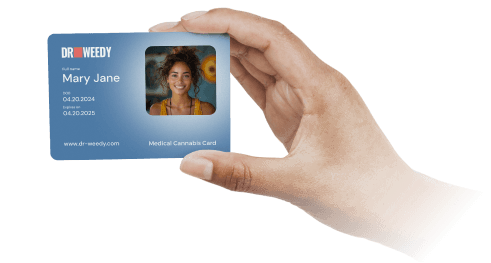
A designated caregiver is a person named on a patient's registration who may buy, carry and — within limits — grow medical cannabis on that patient's behalf. New York registers them automatically with the patient, which removes the separate application that trips people up in other states. This section is the law as it stands; we do not offer services for minors.
A certified patient registered with the Medical Cannabis Program may designate up to five caregivers. There is no separate fee for them.
Caregivers named on the patient registration are auto-registered and receive a registry ID document of their own. Nothing is filed separately.
Patients under 18, or incapable of consent, are required to have one designated caregiver, who is auto-registered with them.
Caregivers must be 18 or older to cultivate at home for a patient, and a caregiver serving two or more patients may cultivate, harvest and dry up to 12 plants for medical use.
A patient or their designated caregiver may purchase up to a 60-day supply, or 3 ounces of cannabis and 24 grams of concentrate, whichever is greater — the caregiver buys within the patient's allowance, not on top of it.
Name or address changes must be reported to the program within 10 business days. Caregiver status follows the patient's certification, so it ends when that certification does.
Sources: OCM, Designated Caregivers; Medical Cannabis Program FAQs; Cannabis Law §3(22). Checked September 2026. Designation happens on the patient's registration — start from how registration works.
Yes, with a condition — and for most visitors the question turns out not to matter, because adult-use retail is open to any adult with an ID. Three situations cover almost everyone.
OCM's FAQ says a visiting patient may purchase at a New York medical dispensary provided you present proof of a certification, registration or the equivalent for your state, together with a valid government-issued photo ID. OCM also advises contacting the medical registered organization first to see what it requires — so treat acceptance as likely, not guaranteed, and call ahead.
Then you need nothing but a government-issued ID. Any adult 21+ may buy at a licensed adult-use dispensary regardless of state of residence. You pay the 13% excise, and you are held to the adult-use limits of 3 ounces and 24 grams.
Possible. Cannabis Law §3(15) defines a certified patient as someone who is a resident of New York State or receiving care and treatment in New York State as determined by the board in regulation. Residency is one route, not the only one.
Cannabis Law §3(15), 2026
Moving here rather than visiting? A New York certification is issued in New York, by a practitioner licensed here — that is what our New York medical card page covers. Staying in your own state, open its rules from the state list at the top of this page.
Only in one narrow way, and the window for it closed years ago. Cannabis Law §131 let towns, cities and villages — never counties — opt out of retail dispensary licenses, on-site consumption licenses, or both. The local law had to be adopted by the later of December 31, 2021 or nine months after the section took effect, and it was subject to permissive referendum under section 24 of the Municipal Home Rule Law.
What the opt-out never touched is the part that matters to a resident: personal possession, home cultivation and the other license types — cultivation, processing, distribution — were outside its reach entirely. A town that opted out has no dispensary; it does not have different possession limits.
A municipality that opted out may reverse it at any time by repealing the local law — §131 expressly allows a repealing law after the deadline. But once it opts back in, OCM states it is not permitted to reverse that decision and opt out again. And a municipality that never opted out can no longer do so: §131 bars any new prohibiting local law after the deadline, and OCM confirms it plainly.
§131 lets towns, cities and villages pass local laws governing the time, place and manner of licensed retail dispensary operation, provided they do not make operation "unreasonably impracticable." Hours, zoning buffers, signage and noise are the usual subjects. They may not adopt a new opt-out, may not prohibit non-retail license types, and may not touch personal possession or home cultivation, which are state law.
Cannabis Law §131, 2026
We do not print a count of municipalities that opted out, and you should be wary of pages that do. OCM publishes the live Official Opt-Out List only as a downloadable spreadsheet — the page recorded it as last updated August 18, 2026 — and notes it is refreshed periodically as localities file late opt-outs or opt back in. The only narrative total the agency ever published dates from January 2022 and is long stale. Check your own town against the current list instead:
Check your town on OCM's Localities page
NYC Health states that adults may smoke or vape cannabis wherever smoking tobacco is allowed under the smoke-free air laws — and then the city's own laws narrow that considerably. It is illegal to smoke or vape cannabis in motor vehicles, even parked ones, and in restaurants, parks, event spaces and any business, including cannabis dispensaries. The NYC Smoke-Free Air Act bans smoking and vaping of any substance in most workplaces and public spaces, and in indoor common areas of residential buildings with three or more units. Smoking where prohibited may bring a civil summons and fine.
In practice that means the city's parks, beaches and pedestrian plazas are off limits even though state law would otherwise allow cannabis smoking wherever tobacco smoking is allowed. Complaints about smoking in prohibited areas go through NYC 311.
Source: New York City Department of Health and Mental Hygiene, checked September 2026. Statewide rules on where you may consume are in where you can use.
Every figure below carries the date its source published it. Where two official numbers exist for the same thing at different dates, both dates are shown rather than blended.
71,187
As of August 1, 2026 — OCM, Medical Cannabis
4,797
As of August 1, 2026 — OCM, Medical Cannabis
717
As stated on the page in September 2026 — OCM, Dispensary Location Verification
$3.3B
Cumulative as of March 27, 2026 — Office of the Governor
This is tax collected by the state, not retail sales. The department notes that quarterly cannabis collections passed wine in September 2023, beer in December 2023 and liquor in June 2025.
Calendar years 2023–2025; page updated May 13, 2026. Source: NYS Department of Taxation and Finance, Tax Facts. Quarterly figures for 2025: $48.5M in March, $55.0M in June, $66.3M in September and $71.6M in December.
The Office of the Governor reported 2,161 adult-use licenses issued statewide as of March 27, 2026, with 56 percent of licenses across the supply chain awarded to Social and Economic Equity applicants and 342 Conditional Adult-Use Retail Dispensary licensees approved. An earlier figure from the same release counted 610 operating retail dispensaries in March 2026 — five months before the 717 shown above, which is why the two are dated separately rather than presented as one trend line.
The medical market is much smaller and structured differently. OCM's Dispensing Facilities directory lists eight registered organizations — Citiva Medical, Curaleaf NY, Etain, Fiorello Pharmaceuticals, NYCANNA, PharmaCann of New York, Valley Agriceuticals and Vireo Health of New York — across 28 dispensing locations, four of them marked temporarily closed at the time of reading. Statute permits each registered organization up to four dispensing facilities.
Sources: Office of the Governor, March 27, 2026; OCM Dispensing Facilities directory, read September 2026. Annual sales broken out by year are published by OCM only in PDF reports and are not reproduced here.
Only changes that took effect, or were signed, during 2026 are listed here. Older rules, however important, belong in the sections above.
April 23–28, 2026
The Justice Department and DEA issued an order immediately placing FDA-approved marijuana products, and marijuana products regulated under a qualifying state medical marijuana license, in Schedule III of the Controlled Substances Act; it was published in the Federal Register on April 28. Adult-use product, unlicensed crops and bulk marijuana remain in Schedule I. This is federal, not New York, law — and it is the single biggest change affecting New York patients this year.
U.S. Department of Justice, April 23, 2026
June 3, 2026
The revised packaging, labeling, marketing and advertising regulations (9 NYCRR Parts 128 and 129) took effect December 3, 2025, with expanded marketing flexibility, clearer signage rules and authorization of rewards and loyalty programs. Selected packaging and labeling amendments had a six-month delay, with compliance required by June 3, 2026. For a shopper, the visible effects are loyalty programs and changed labels.
July 2, 2026
The Cannabis Control Board adopted Resolution No. 2026-18 on March 5, 2026, directing OCM to file proposed amendments to 9 NYCRR Part 113, the medical cannabis regulations, for public comment; the Board took the regulations up for adoption at its meeting of July 2, 2026, alongside approving 24 new adult-use licenses. The final adopted text was not confirmed from an official source when this page was reviewed, so no specific new provision is described here.
Cannabis Control Board meeting materials, July 2, 2026
August 6, 2026
Governor Hochul signed S.10113/A.11217, allowing licensed cannabis microbusinesses and dispensaries to take part in Cannabis Showcase Events at approved locations, including pop-ups, farmers' markets and public market events. OCM's rules require municipal approval before it can issue an event permit. The press release states no effective date.
Office of Governor Kathy Hochul, August 6, 2026
These are bills. They are not rules, and nothing in them applies to you today. Both were referred to committee on January 7, 2026 in the 2025–2026 session.
Bill trackers are convenient, not authoritative — the official text lives at nysenate.gov.
Every link here goes to a state or city agency or to the text of the law. Bookmark the first two — verifying a shop and finding a medical dispensary are the two things people need repeatedly.
For a medical emergency after using cannabis, OCM's incident page lists the Poison Center at (800) 222-1222. Adopted regulations sit in Title 9 NYCRR: Part 113 for the medical program (effective March 27, 2024), Parts 118–131 for adult use (effective November 5, 2025), and Parts 128–129 for packaging and advertising (effective December 3, 2025).
Not to buy at all — any adult 21 or over may buy at a licensed adult-use dispensary with a photo ID. A certification matters for four things: you pay no 13% excise tax at a medical dispensary, your possession limit becomes a 60-day supply where that exceeds 3 ounces, you reach medical-only forms such as transdermal patches and metered preparations, and you gain the standing described in Cannabis Law §42, which deems a certified patient to have a disability under the Human Rights Law. Under 21, the medical program is the only lawful route.
An adult 21 or over may possess 3 ounces of cannabis and 24 grams of concentrate outside the home. A registered patient may hold a 60-day supply, or 3 ounces and 24 grams, whichever is greater. At a private residence you may keep up to 5 pounds of your own harvest in a secured place not accessible to anyone under 21, under Penal Law §222.15.
Three mature and three immature per adult 21 or over, and no more than six mature and six immature in any private residence, however many adults live there. Cultivation is permitted only within, or on the grounds of, your private residence, plants must be kept away from anyone under 21, and selling homegrown cannabis is prohibited. A designated caregiver with two or more patients may grow up to 12 plants. Going over the state limit is a civil penalty of up to $125.
OCM's FAQ says a visiting patient may buy at a New York medical dispensary on presenting proof of a certification, registration or equivalent from their state together with a valid government-issued photo ID — and advises contacting the registered organization first to see what it requires. If you are 21 or over, you can also simply buy at an adult-use dispensary with your ID and no card at all.
Carrying cannabis across a state line is a federal offense under 21 U.S.C. §841(a), whatever the law of your destination. TSA lists medical marijuana as allowed in carry-on and checked bags subject to special instructions, and states that its officers do not search for drugs but refer any illegal substance found during screening to law enforcement, with the final decision on any item resting with the officer at the checkpoint. Check TSA's own page before you pack.
Labor Law §201-D(2) protects legal cannabis use that happens outside work hours, off the employer's premises and without the employer's equipment. The exceptions in §201-D(4-a) cover action required by law, roles where federal law or funding is at stake, and cases where you show specific articulable symptoms while working. New York State Department of Labor guidance explains that a cannabis test does not by itself establish impairment, and that the smell of cannabis alone is not an articulable symptom.
Federal law says no. 18 U.S.C. §922(g)(3) bars an unlawful user of a controlled substance from possessing firearms or ammunition, and ATF treats a marijuana user as an unlawful user regardless of state authorization. The April 2026 rescheduling moved state-licensed medical product to Schedule III but did not remove marijuana from the Controlled Substances Act. Cannabis Law §127 does not list firearms among its protected domains, and state law cannot override federal law here. Take this one to a lawyer.
No. Vehicle & Traffic Law §1192(4) prohibits driving while your ability is impaired by a drug, and no subdivision of §1192 sets any numeric blood, breath, urine or saliva threshold for cannabis — unlike the express .08 limit for alcohol. Impairment is established by observation and Drug Recognition Expert evaluation. The penalty is in §1193(1)(b): a misdemeanor with a fine of $500 to $1,000 and up to one year, with a class E felony for a repeat within ten years.
Three checks, all published by OCM. Licensed dispensaries post a Dispensary Verification Tool — a QR placard near the entrance that leads to OCM's list of licensed dispensaries. Regulated products carry the New York State universal symbol. And every product links to its Certificate of Analysis by QR code or link. You can also look up an address in advance on OCM's Dispensary Location Verification page or the Buy Legal map.
By seeing a New York-licensed practitioner again. A certification runs up to two years, but your provider may have set a shorter end date, so check the document rather than assuming. The state fee is $0 for a renewal as it is for a first certification, and the new certification carries its registry ID the same way. The practical steps are on our New York renewal page.
They are gone. Since the program was simplified, the certification itself contains a registry ID and can be used immediately together with a government-issued photo ID at a licensed medical dispensary. Patients are auto-registered rather than filing separately, and designated caregivers named on the registration receive a registry ID document of their own.
Only if it opted out by the deadline in Cannabis Law §131 — the later of December 31, 2021 or nine months after the section took effect — and only from retail dispensary and on-site consumption licenses. Counties could never opt out. A town that missed the deadline can no longer opt out, and one that opts back in cannot reverse again. Personal possession and home cultivation were never affected. Check the current list on OCM's Localities page. Finding a shop near you is covered in our guide to medical marijuana dispensaries in New York.
The questions this page cannot answer are the ones about your own case: what the practitioner will ask, what happens if they decide against certifying you. Those are on our New York medical card page.
If the tax difference, the larger limits or the medical-only forms matter to you, the next step is a conversation with a New York-licensed practitioner — online, and with no state fee to register afterwards.
Our New York page explains how the evaluation works and what follows it.
Start with a New York practitioner
Listed in the order the sections above use them. Each entry names the agency or document and the date the information was accurate. Links inside the sections stay where they are — this list is for checking our work, not for replacing them.
Some official material — OCM annual reports, several 2026 Board press releases, the opt-out spreadsheet — is published only as PDF or spreadsheet files. Where a figure exists only in those files, this page says so rather than repeating an unverified number.
This page is a reference guide to New York State law. It is not legal advice and not medical advice, and it does not replace a consultation with a licensed practitioner or an attorney.