


Medical Marijuana Card in Los Angeles, CA: How to Get One


- California state program
- Physician licensed in California
- Online, no office visit
Yes. Los Angeles residents qualify through California’s statewide medical cannabis program, not a city program, so there is nothing separate to apply for at City Hall. If you are 18 or older, live in California and have a condition that a physician licensed in California believes cannabis may help, that physician can write you a recommendation after an online appointment. A state ID card (MMIC) is optional and, for people who live in LA County, is issued by the county’s Department of Public Health.
Approval is never automatic: the physician decides after reviewing your health history.
In short
-
Who qualifies
Adults 18 and over who live in California and have a serious or chronic condition. Your Los Angeles address simply places you in LA County for the optional ID card.
-
Who decides
A physician with an active California license. No form, quiz or website can approve you on its own.
-
Where it happens
Online, from home. One program covers the whole state, so there is no need to travel to another city or a clinic.
-
How your status is recorded
A signed physician’s recommendation. If you want the sales tax exemption, you add the county-issued MMIC on top of it.
The order of steps, from records to recommendation, is laid out below.
Living with a long-term condition in Los Angeles and not sure the medical route is for you?
Many people who read this have been dealing with the same pain, sleepless nights or anxiety for months. The usual treatment helps a little, or not at all, or comes with side effects they would rather avoid. Cannabis keeps coming up in conversation, and then the questions start: is it legal for me, will my employer find out, and would a doctor even take me seriously?
Los Angeles makes the picture noisier than it needs to be. The city, the county and the state each have their own rules, shops sell hemp and delta-8 products that sit outside the medical system, and advice online contradicts itself. Driving and work rules add one more layer of worry.
The medical route is slower than buying something on impulse, and that is the point. A physician licensed in California looks at your history, your medicines and your goals, and tells you plainly whether cannabis has therapeutic potential for your symptoms. It is a medical conversation about relief, not a promise of a cure. If the answer is yes, you leave with a recommendation that protects you under state law.
If you are still deciding, read on at your own pace. Each section below answers one question a Los Angeles patient usually asks, in the order they tend to come up.
How does California’s medical cannabis program work for a Los Angeles resident?
California has protected medical use since voters passed Proposition 215, the Compassionate Use Act, in 1996 (Health and Safety Code §11362.5) [1]. In 2003 the Legislature added SB 420, the Medical Marijuana Program Act, which defines qualifying conditions and created a voluntary state ID card (§11362.7 and following) [2].
The card, called the Medical Marijuana Identification Card or MMIC, is a program of the California Department of Public Health, but counties take the applications [3] [4]. For anyone living in Los Angeles County, that is the Environmental Health Division of the county Department of Public Health [5]. Recreational use has also been legal for adults 21 and over since 2016 [6], so the medical route matters most for what it adds on top.

Legal status
| Medical patient | Adult 21+ |
|---|---|
| Protected from age 18 with a physician’s recommendation Prop 215 and SB 420 [1] | Legal from 21 Prop 64 [6] |
Recreational use is legal at 21
Possession
| Medical patient | Adult 21+ |
|---|---|
| 8 oz of dried cannabis or more if your physician says you need it [7] | 28.5 g of cannabis and up to 8 g of concentrate [6] |
Cities and counties may allow more for patients
Home cultivation
| Medical patient | Adult 21+ |
|---|---|
| 6 mature or 12 immature plants or more on a physician’s advice [7] | 6 living plants per residence [6] |
Local rules on where you grow can be stricter
Sales tax
| With an MMIC | Without an MMIC |
|---|---|
| Exempt show the MMIC and a government ID [8] | Paid a recommendation alone does not exempt you |
Cannabis excise tax applies to everyone
Two corrections to what older guides say. The Compassionate Use Act is Proposition 215, not SB 420. And a medical recommendation does not allow use in public places: the same bans apply to patients as to everyone else [9].
Over 21 in Los Angeles: what does the medical route add?
If you are 21 or older you can already buy at any licensed retailer with a photo ID. The medical route is about what sits on top of that:
- Access from 18. Licensed medicinal retailers may serve patients aged 18 to 20 who hold a physician’s recommendation; the adult-use market starts at 21 (Business and Professions Code §26140) [10].
- Higher possession and cultivation limits, set by state law and adjustable by your physician [7].
- No state and local sales tax on medicinal purchases, but only once you also hold the county MMIC [8].
- A medical record of the decision. Your physician knows what else you take and can tell you what to watch for, which a store clerk cannot.
What it does not mean is stronger products. Older articles claimed medical cannabis is more potent; the difference is in who may buy, how much and at what tax, not in some special grade kept behind the counter.
For limits, transport and penalties statewide, see the full California cannabis law guide.
City of Los Angeles, another LA County city or an unincorporated area: whose local rules apply to you?
“Los Angeles” on an envelope can mean three different things. You may live inside the City of Los Angeles, in one of the other incorporated cities of LA County such as Pasadena or Long Beach, or in an unincorporated area that has no city government at all. Your recommendation and an MMIC work the same everywhere in California; local rules only change where you may use cannabis and what licensed businesses can operate near you.

If you live in the City of Los Angeles
Licensed cannabis sales are legal in the city. In 2017 Los Angeles voters told the City to create a legal path for medical and adult-use businesses, and the City set up the Department of Cannabis Regulation (DCR) to license them [11]. Older claims that retail cannabis is “illegal in LA” are out of date.
Where you may not use it is set by Ordinance 187525 of 2022. It counts cannabis smoke and vapor as “smoking” and bans it in City-owned or leased buildings, at City-permitted farmers’ markets and in outdoor dining areas, and in City parks, playgrounds, beaches, piers and trails [12]. Breaking the rule is an infraction.
On-site consumption lounges are not open to the public as a general rule. In December 2025 the DCR proposed a pilot for existing licensed storefronts and noted that no cannabis events in the City were licensed at the time; whether the Council adopted it has not been confirmed [13].
If you live in another city in LA County
Each incorporated city writes its own ordinances on licensed businesses, smoking in public areas and growing at home within state limits. Check the municipal code on your city’s website before you assume LA city rules apply. For a few neighboring cities we have separate guides: Pasadena, Long Beach and Santa Monica.
The MMIC is still a county card. Every LA County resident, whatever their city, applies through the county Department of Public Health [5].
If you live in an unincorporated area
Areas without a city government follow Los Angeles County’s own ordinances in place of a city code. State limits on possession and growing still apply, and the county decides local zoning and business rules.
You apply for the MMIC at the same county program as everyone else in LA County [5].
The same everywhere in LA County: no use in public places or while driving, a recommendation that is valid statewide, and the MMIC issued by the county.
What a card does not allow anywhere in Los Angeles is set out further down.
Which conditions can qualify a Los Angeles patient in California?
California law names a set of “serious medical conditions” and then adds a broad clause, so the list is a starting point rather than a fence [2]. Under that clause, a physician may also recommend cannabis for
“any other chronic or persistent medical symptom that either substantially limits the ability of the person to conduct one or more major life activities as defined in the Americans with Disabilities Act of 1990, or if not alleviated, may cause serious harm to the patient’s safety or physical or mental health.”
California Health and Safety Code §11362.7(h) [2]
Type part of a name to narrow both lists.
Named in California law 13
- AIDS
- Anorexia
- Arthritis
- Cachexia
- Cancer
- Chronic pain
- Glaucoma
- Migraine
- Persistent muscle spasms
- Multiple sclerosis
- Seizures
- Epilepsy
- Severe nausea
Not on either list? The broad clause above may still cover it. Your physician decides at the appointment, and the checklist below helps you prepare.
Whether your condition counts is a medical judgment made at the appointment, based on your history and records. The second list is not a promise: it shows conditions patients commonly bring up, which a physician weighs under the broad clause case by case.
Each condition has its own page with research and practical notes in our conditions library.
Who can get a medical marijuana card in Los Angeles, and what do you need?
Four things matter. You are 18 or older. You live in California, and can show it. You have a government photo ID. And you have a condition that a California physician agrees may respond to cannabis. Medical records are not a legal requirement for the appointment, but they make the conversation faster and more precise, so it is worth collecting what you have before you book.
The recommendation itself is valid for a period your physician sets, and it is renewed with a new appointment; renewal works the same way as the first visit. Where you start depends on your situation, so pick yours below.
Where are you now?
How to get a medical marijuana card in Los Angeles, step by step
The whole route runs online until the optional county card. These are the steps in the order you take them.
-
Check your condition and gather records
Compare your diagnosis with the California list and collect what you have: visit notes, imaging, prescriptions, or simply a written list of diagnoses and medicines.
-
Apply online
Fill in a short health questionnaire, upload your ID and any records, and choose a time for the appointment.
-
See a California-licensed physician
One-on-one, from home. You agree the time with the physician; keep an hour free around it rather than a single minute, in case the previous patient runs long.
-
Receive your recommendation
A physician who decides in your favor signs a written recommendation, and we email it to you as a PDF. If the answer is no, the physician explains why.
-
Apply for the LA County MMIC
Only if you want the state ID card and its sales tax exemption. It is a separate, in-person county process, described below.
Then the medicine itself: buy only from a state-licensed retailer, which you can confirm in the Department of Cannabis Control license search [14].
What happens after your online visit?
The recommendation is a document, not a plastic card. Keep the PDF on your phone or print it, and bring it together with your photo ID when you buy. The licensed retailer checks that the recommendation is genuine and current before serving you as a medical patient.
If you ordered a printed card with your package, it is mailed separately; the California page lists what each package includes. Nothing arrived, or the email went missing? Check your spam folder first, then contact support through your patient account, where your documents are also stored.
Not the same thing
Hemp and delta-8 shops, smoke shops and gas stations are not cannabis retailers licensed by the Department of Cannabis Control. A recommendation changes nothing at their counter, and the medical sales tax exemption does not apply there.
Prices, packages and how the California appointment runs are on one page.
See the California appointmentWhat is a “420 evaluation”, and is an online visit legal for Los Angeles residents?
“420 evaluation” and “420 doctor” are the phrases people type into search. Behind them is an ordinary medical appointment: a licensed physician reviews your history and symptoms and decides, on medical grounds, whether to recommend cannabis. There is no special “420” license and no shortcut around that judgment.
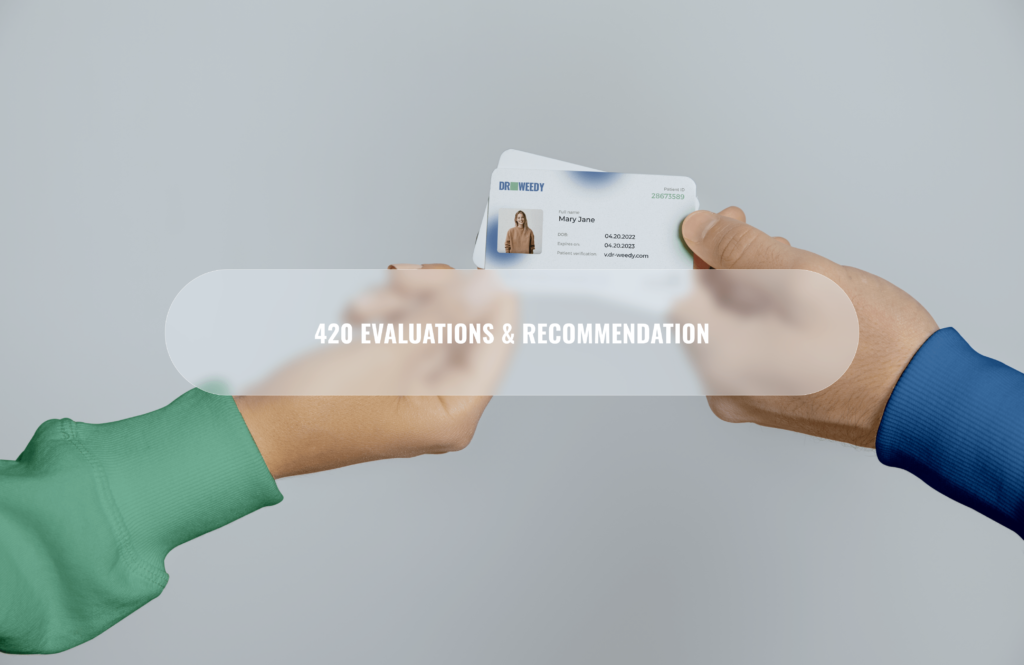
Getting a medical marijuana card in Los Angeles online
California allows physicians to care for patients by telehealth, meaning a remote appointment instead of an office visit, as long as the patient consents (Business and Professions Code §2290.5) [15]. The same law that governs cannabis recommendations requires an appropriate prior examination in good faith before one is issued (§2525.3) [16]. An online appointment meets that standard when the physician actually examines and questions you; a form that approves itself does not.
Expect about 15 minutes. The physician asks what you are treating, how long it has lasted, what you have tried and what else you take, and may ask follow-up questions about sleep, mood or work. You can ask your own questions too; the list in the forms section is a good place to start.
Who reviews your case, and how do you check a California physician’s license?
Your case is reviewed by a physician who holds an active license in California, one on one. You do not need to take that on trust. Look the physician up by name in the Department of Consumer Affairs license search, which covers the Medical Board of California [17], or at the Osteopathic Medical Board of California for a DO [18]. The national NPI Registry confirms the provider number and specialty [19].
Red flags
A service that promises approval before anyone has seen you, issues a recommendation without an examination, or charges extra for a “guarantee” is not following California law. Walk away.
Across 250 reviews from patients in the states where we are licensed. We do not sort them by score and do not hide the low ones.
- 150,000+patients evaluated – everyone who has been through an appointment with us, in every state where we are licensed
- Since 2017doing only this: online evaluations for medical cannabis programs, and nothing else on the side
Read who our physicians are and how they work on the doctors page.
When you are ready, see how the California appointment works.
Physician’s recommendation or LA County MMIC: do you need both?
No. The recommendation is the document that makes you a medical patient, and it is enough to buy at a licensed medicinal retailer. The MMIC is a voluntary state ID card layered on top of it; the main practical reason to get one is the sales tax exemption [3] [8].
| Question | Physician’s recommendation | LA County MMIC |
|---|---|---|
| Who issues it | A physician licensed in California | LA County Department of Public Health, under the CDPH program [5] [4] |
| Needed to buy? | Yes, for medical purchases | No, it is voluntary [3] |
| How long it lasts | The term your physician sets | One year at most, and never longer than the recommendation [20] |
| Sales tax | Paid as usual | Exempt on medicinal purchases, with a government ID [8] |
| Privacy | Part of your medical record | Program records are confidential by law [21] |
| Cost | Set by the provider; ours is on the California page | $100, or $50 for Medi-Cal beneficiaries (county fees for FY 2026-2027) [22] |
County fees: Los Angeles County Department of Public Health, FY 2026-2027 fee schedule. The reduced Medi-Cal fee follows state law [23].
How do Los Angeles County residents apply for the MMIC?
Only LA County residents apply through the county program; people in other counties go to their own county agency [5]. The county describes an in-person process:
Prepare the packet. The county asks for a Physician Attestation and medical documentation dated within 30 days of your application [24]. State law also asks every applicant for proof of identity and proof of residency in the county [25].
Submit and pay. The fee is due when you submit, by money order or cashier’s check, and it is not refunded [24] [22].
Wait for processing. The county allows 30 days from the day it receives your application [24].
Collect the card. Book a pickup within 30 days of it being ready, or ask for USPS Certified Mail to the address on your application [24].
Check first
The county’s 2023 form lists the Medical Marijuana Program at 5050 Commerce Drive, Baldwin Park, CA 91706, phone (866) 621-2204 [24]. Older county pages still point to an office on N. Figueroa St. that stopped card services in 2018, so call to confirm the current location and appointment days before you go. An incomplete packet may be denied and can bar you from reapplying for six months; a packet older than 60 days is not processed. A lost or damaged card means a new application and a new fee [24].
On caregivers, California law defines a primary caregiver as the person a patient designates who has consistently taken responsibility for the patient’s housing, health or safety [2]. In LA County one designated caregiver can be linked to up to five patients’ cards, and a caregiver may collect both their own card and the patient’s [24].
How much sales tax could an LA County MMIC save you?
With an MMIC and a government ID, medicinal purchases are exempt from California sales and use tax [8]. Set your own numbers to see what that is worth to you.
What you spend at licensed retailers in a typical month, before tax.
$0$1,000
Rates differ from one address to the next in LA County. Look up yours in the CDTFA sales and use tax rates [26], then set it here.
7.25%, statewide base11.50%, high end
Sales tax not charged per year
- Per month
- County fee paid back in
Move either slider to see your result.
The exemption covers sales tax only. The state cannabis excise tax and any local cannabis business taxes still apply, and a recommendation without an MMIC does not unlock the exemption.
The card itself, and how it differs from a recommendation in daily use, is covered on our MMIC page and in MMIC vs. recommendation.
Forms of medical cannabis, side effects and what to ask your LA physician
Cannabis is not only something people smoke. Patients inhale it, swallow it, hold it under the tongue or apply it to the skin, and each route reaches the body differently. The form that suits you is a conversation with your physician; this section explains which risks belong to which form, so that conversation starts from the right place. It does not suggest one form over another.
Choose a form above; the layers that apply to it stay highlighted.
Airways
Smoke and hot vapor pass through the throat and lungs and can irritate them, which matters with asthma, COPD or a cough. This layer belongs to inhaled forms only.
Applies to: inhaled
Does not apply to this form
Any form
THC affects attention and reaction time whatever the route, so driving is off the table. Cannabis can interact with other medicines and add to the drowsiness some of them already cause. Your physician needs your full medicine list.
Applies to: every form
Does not apply to this form
Slow onset
What you swallow passes through the liver first, so it takes longer to start and lasts longer. Taking a second dose because the first “did not work yet” is a common cause of taking too much.
Applies to: swallowed
Does not apply to this form
THC and CBD are separate questions. A risk that comes from THC does not automatically apply to a CBD-only product, and the reverse is also true, so ask about the composition as well as the form.
Prescription cannabinoid medicines approved by the FDA, such as dronabinol, nabilone and Epidiolex (cannabidiol), are a different category: they are filled at a pharmacy on a prescription, not bought with a medical cannabis recommendation.
Questions to bring to your appointment
- Could cannabis interact with anything I take now, including over-the-counter medicines?
- Which form makes sense with my other conditions, for example my lungs or my liver?
- What should I know about THC and CBD for my symptoms?
- How will it affect my sleep, my mood and my work the next day?
- What signs mean I should stop and call you?
One example of an interaction worth asking about: cannabis and Xanax.
Where can you legally use medical cannabis in Los Angeles, and what does a card not protect?
Not allowed, card or no card
Smoking or vaping in a public place, anywhere tobacco smoking is banned, and using cannabis while driving or riding in a vehicle are all against state law [9]. In practice, use stays at home or on private property where the owner allows it.
Below, each card opens to the rule and its source. The first line of each is the short answer.
Public places and smoking bansNot in public, and not where smoking is banned.
DrivingNever while driving or riding, and no open package in the car.
Using cannabis while driving or as a passenger is prohibited, and an open container in the vehicle is an offense of its own [9]. Impaired driving is a DUI whatever form you used; a recommendation is no defense.
Work in CaliforniaOff-duty use is largely protected, with exceptions.
Since 2024, Government Code §12954 (AB 2188 and SB 700) bars most employers from penalizing off-the-job use or tests that only find inactive metabolites, and from asking about past use [27]. Being impaired at work is still not protected. Construction-trade employers sit outside the rule, and so do roles where federal law, a federal contract or a security clearance calls for drug testing.
Commercial drivers (DOT and CDL)Federal testing rules apply regardless of a card.
Under federal Department of Transportation rules, a medical review officer may not treat a state recommendation as a reason to clear a positive test (49 CFR §40.151(e)) [28]. If you hold a CDL or work in a DOT-tested job, discuss this with your physician before you start.
FirearmsFederal law treats cannabis users as prohibited buyers.
Cannabis remains a federally controlled substance, and federal law bars its users from receiving or possessing firearms (18 U.S.C. §922(g)(3)) [29]. The ATF Form 4473 that every buyer signs asks this question directly. State medical status does not change the federal answer.
Federal land and airportsState protection stops where federal property begins.
National forests such as the Angeles National Forest, national park sites and other federal property follow federal law, under which cannabis is not legal. Airport security screening is federal too. Leave cannabis at home when you head into federal land or fly.
Travel outside CaliforniaA California recommendation stays in California.
Carrying cannabis across state lines is a federal matter even between two legal states. A few states recognize visiting patients and many do not; check the destination before you travel. California, for its part, does not accept cards issued elsewhere.
PrivacyMedical and MMIC records are confidential.
Information you give the county for an MMIC is confidential under state law [21]. Your appointment record is protected like any other medical record.
Which states accept visiting patients, and on what terms, is covered in our guide to out-of-state cards.
How long does a California recommendation last, and how do you renew it from Los Angeles?
Your physician sets the term of the recommendation. An MMIC is valid for one year at most and cannot outlast the recommendation behind it [20]. Book the renewal appointment a few weeks before the end date so there is no gap, then take the new recommendation to the county if you also renew the MMIC.
The steps and documents are on the California renewal page.
What does the visit cost, and what if you’re not approved?
Our California appointments start from $39. What each package includes, and what happens to your payment if the physician does not approve you, are set out on the state page, so you can read the terms before you book.
Medical marijuana card in Los Angeles: FAQ
How fast can I get a medical marijuana card in Los Angeles online?
The application takes about 5 minutes and the appointment about 15. The start time is agreed with the physician, and the recommendation follows once the physician approves. The county MMIC is slower: LA County allows 30 days to process it [24].
Can I get a medical card in Los Angeles at 18?
Yes. Adults from 18 can be evaluated, and licensed medicinal retailers may serve recommended patients aged 18 to 20, while adult-use stores start at 21 [10].
Is an online 420 evaluation legal in California?
Yes, when a California-licensed physician actually examines you before recommending cannabis. The law behind remote appointments and the good-faith examination rule is explained above [15] [16].
Does California accept out-of-state medical cards?
No. If you have moved to Los Angeles, you need California residency and a recommendation from a physician licensed here. The out-of-state cards guide lists where cards do travel.
Do I need the county MMIC to buy medical cannabis?
No. The physician’s recommendation is enough to buy at a licensed medicinal retailer. The MMIC is voluntary; it adds the sales tax exemption [3] [8]. Use the calculator above to see whether it pays off for you.
Is delta-8 or hemp the same as medical cannabis?
No. Products sold in hemp, smoke and convenience shops are not sold by cannabis retailers licensed by the Department of Cannabis Control, and your recommendation plays no part there. Check any seller in the DCC license search [14].
More answers for California patients are in the California FAQ.
Your next step toward a medical card in Los Angeles
Nothing here has to happen today. When you are ready, the path is short, and the decision stays with a physician who has looked at your case.
-
Gather what you have
ID, proof of residency and any records. The checklist shows what is left.
-
Talk to a California physician
An online appointment of about 15 minutes; if approved, the recommendation comes by email.
-
Decide on the MMIC, mark the renewal date
Add the county card if the tax saving is worth it, and renew before the end date.
Everything about the California appointment, prices included, starts on one page.
Get your California medical cardNew to Dr. Weedy? See how the service works.
Medical cards in other California cities
What has changed recently for Los Angeles patients?
March 3, 2026
A City Council motion asked the Department of Cannabis Regulation to report on opening delivery and cultivation licenses, until now limited to social equity applicants, to general applicants [11].
December 15, 2025
The Department of Cannabis Regulation proposed a licensing program for consumption lounges and temporary events, with an on-site pilot for existing licensed storefronts. Its adoption has not been confirmed [13].
FY 2026-2027
LA County’s fee schedule keeps the MMIC fee at $100, or $50 for Medi-Cal beneficiaries [22].
The official sources to bookmark: the CDPH Medical Marijuana Identification Card Program [4], the LA County MMIC page [5], the DCC license search [14] and CDTFA tax rates [26]. When a rule changes, these pages change first.
This article is for information only. Whether cannabis is right for you is decided by a physician at your appointment, and MMIC registration is handled by the county under the state program.
References
29 sources
- 1. California Legislative Information. Health and Safety Code §11362.5 (Compassionate Use Act). 1996.
- 2. California Legislative Information. Health and Safety Code §11362.7. 2003.
- 3. California Legislative Information. Health and Safety Code §11362.71. 2003.
- 4. California Department of Public Health. Medical Marijuana Identification Card Program. 2026.
- 5. County of Los Angeles Department of Public Health, Environmental Health. Medical Marijuana Identification Card. 2026.
- 6. California Legislative Information. Health and Safety Code §11362.1 (Proposition 64). 2016.
- 7. California Legislative Information. Health and Safety Code §11362.77. 2003.
- 8. California Legislative Information. Revenue and Taxation Code §6371. 2016.
- 9. California Legislative Information. Health and Safety Code §11362.3. 2016.
- 10. California Legislative Information. Business and Professions Code §26140. 2017.
- 11. Los Angeles City Council. Government Operations motion, Council File 26-0301. 2026.
- 12. Los Angeles City Clerk. Council File 18-1104, Proof of Publication of Ordinance No. 187525. 2022.
- 13. City of Los Angeles Department of Cannabis Regulation. Report to City Council, Council File 24-1584. 2025.
- 14. California Department of Cannabis Control. Cannabis License Search. 2026.
- 15. California Legislative Information. Business and Professions Code §2290.5. 2011.
- 16. California Legislative Information. Business and Professions Code §2525.3. 2015.
- 17. California Department of Consumer Affairs. License Search. 2026.
- 18. Osteopathic Medical Board of California. License verification. 2026.
- 19. Centers for Medicare and Medicaid Services. NPPES NPI Registry. 2026.
- 20. California Legislative Information. Health and Safety Code §11362.745. 2003.
- 21. California Legislative Information. Health and Safety Code §11362.713. 2003.
- 22. County of Los Angeles Department of Public Health, Environmental Health. FY 2026-2027 Public Health and Financial Management Fee Schedule. 2026.
- 23. California Legislative Information. Health and Safety Code §11362.755. 2003.
- 24. County of Los Angeles Department of Public Health. Medical Marijuana Program Acknowledgement Form (revised 2/2023). 2023.
- 25. California Legislative Information. Health and Safety Code §11362.715. 2003.
- 26. California Department of Tax and Fee Administration. Sales and Use Tax Rates. 2026.
- 27. California Legislative Information. Government Code §12954. 2024.
- 28. Electronic Code of Federal Regulations. 49 CFR §40.151. 2026.
- 29. Office of the Law Revision Counsel, U.S. House of Representatives. 18 U.S.C. §922. 2026.



God bless everyone who helped me get my MMJ card in Los Angeles. Now I can buy cannabis and feel better than before. Dr. Weedy, good work! Don’t let me down next time! From now I will always choose only you