


Smoking Decarbed Weed: Effects, Potency, Color and Risks

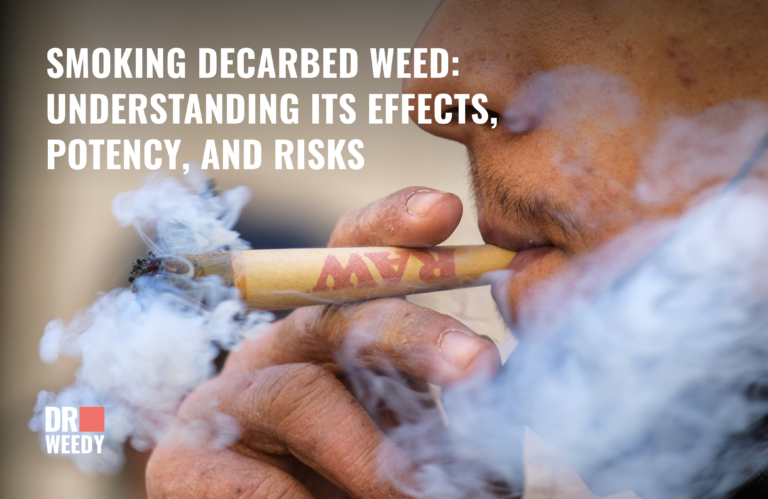
Yes, you can smoke decarbed weed, and the THC in it is already active. No, it won’t get you higher: a flame turns THCA into THC on the spot, so heating the flower in an oven first mostly costs aroma and some of the THC. Decarbing matters for cannabis you eat or hold under the tongue, where effects start later and last longer, while smoke still reaches your lungs whichever way the flower was prepared.
In short
| Smoking flower that’s already decarbed | Works, but no strongerThe flame does the same job the oven did. |
|---|---|
| Decarbing before you smoke | Not neededThe extra heat dries the flower and drives off aroma. |
| What decarbed flower looks like | Dry, light golden-brownNot dark brown or black: that means it was overheated. |
| Why people decarb at all | For edibles, oils and tincturesRaw THCA barely affects you unless it is heated. |
Bottom line: smoke is still smoke whether or not the flower was decarbed, THC acts the same way and interacts with the same medicines in any form, and which form fits a health need is a question for a doctor.
What does “decarbed” mean? Decarboxylation explained
“Decarbed” is short for decarboxylated: cannabis that has been heated so that THCA, the acid form the plant makes, loses a small carboxyl group and becomes THC, the compound that changes how you feel. CBDA goes through the same change and becomes CBD.
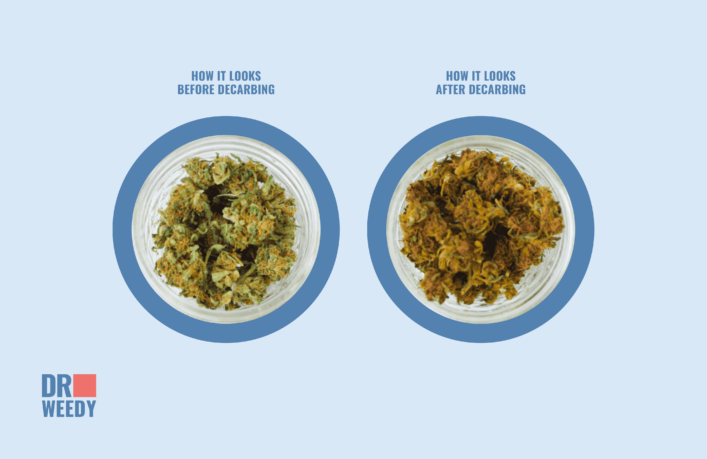
That is where the confusion starts. “Activated” sounds like “stronger,” recipes insist on decarbing, and the same word gets used for flower, oils and concentrates that behave very differently. So people reasonably ask whether decarbing first will make a joint hit harder, whether a dab or a cartridge still needs it, and whether the brown crumbs on the baking sheet came out right. Each of those has a short answer, and the chemistry below is what ties them together.
THCA
Acid form in the raw plant
Fresh or dried flower that has not been heated
THC
The active, intoxicating form
Smoke, vapor, decarbed flower, most edibles
CBN
What THC breaks down into
Overheated or old, poorly stored cannabis
The chemistry behind decarboxylation
Heat does the work, and it never converts everything at once. A lab analysis of cannabis oils showed that even a hot instrument converts only part of the acids, about 50–60% in that setup, which is why testing methods have to account for THCA separately [1]. That was a laboratory analysis, not a kitchen, but the lesson carries over: home decarbing is always partial.
Federal hemp rules make the same point in their own way. When labs report “total THC,” they add the THC already present to 87.7% of the THCA, because that is the share of the acid’s weight left as THC once heat strips off the carboxyl group [2]. Heat can also push other cannabinoids around: in a lab study, CBD heated the way an e-cigarette heats it partly turned into THC [3]. Once THC is in your body, it acts through the endocannabinoid system; here is how that system works.
Importance in consumption and preservation
Decarbing matters when nothing else will heat the cannabis. Brownies, infused butter, capsules and most tinctures rely on THC that was activated beforehand, because digestion does not do that job. Smoking and vaporizing are different: the heat of use converts THCA in the moment, so decarbing first adds a step without adding strength.
Decarbing does not preserve cannabis. Activated THC keeps breaking down toward CBN with heat, light and air, so decarbed flower loses strength over time like any other cannabis; how to slow that is covered in how long it keeps.
Why raw cannabis in a smoothie does little
Raw flower is mostly THCA, which is not intoxicating, and the stomach does not heat it into THC. Raw cannabis that is eaten therefore behaves very differently from an edible made with decarbed cannabis.
What should decarbed weed look like? Color, texture and smell
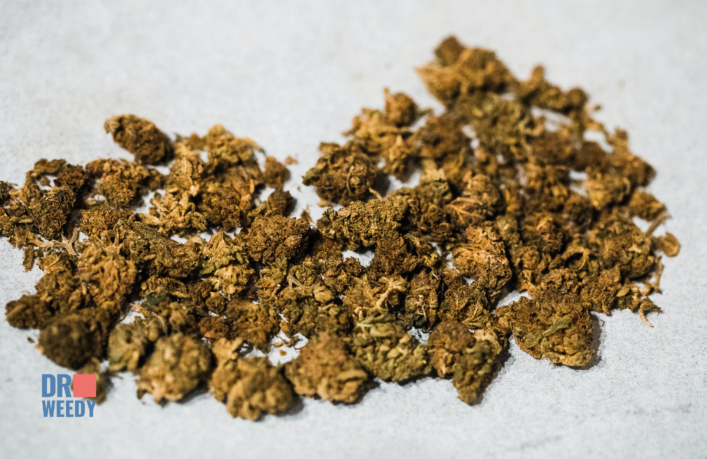
Properly decarbed cannabis turns a light to medium golden-brown and becomes dry and brittle, crumbling easily between your fingers, but it should not be dark brown or black. The three stages below are the usual way to read it, with words instead of color swatches, since screens shift color more than descriptions do.
Not decarbed yet
| Color | Greenas it came, or slightly dull |
|---|---|
| Texture | Slightly springymay still feel a little moist |
| Smell | Fresh and plant-likethe strain’s usual aroma |
Mostly THCA
Decarbed
| Color | Light to medium golden-brownsome green can show through |
|---|---|
| Texture | Dry and brittlecrumbles between fingers |
| Smell | Toasty, nuttystrong while heating, fainter after |
THCA turned into THC
Overheated
| Color | Dark brown to blackedges first |
|---|---|
| Texture | Powdery, charred bitsturns to dust when pressed |
| Smell | Burnt and sharplike scorched toast |
Some THC lost to CBN
Can decarbed weed still be green?
Yes. Strains differ in color to begin with, and a pale green or olive tint after heating is common, especially with gentle, even heat. Color shift is a sign that heating happened, not a measure of how much THCA converted. Flower that is still bright green and springy, though, probably did not get enough heat.
Does decarbed weed have to be brown?
No. Golden to light brown is typical, but there is no shade that proves a batch is done, and chasing a darker brown is how batches end up overheated. Dry texture and a toasty smell, together with the time and heat you used, tell you more than color alone.
How to tell if weed is decarbed
Color and smell are hints, not proof. At home you can only read signs; a lab test is the only way to know how much THCA turned into THC.
How is cannabis decarbed at home, and why is home heat imprecise?
At home, cannabis is decarbed with low, steady heat in an oven: a thin, even layer, no open flame, and enough time for the moisture to leave and the THCA to convert. The weak point is the oven itself. Home ovens swing above and below the dial setting, and a thick or uneven layer heats unevenly, which is why one batch comes out underdone and the next scorched.
Break it up coarsely
Pieces the size of a grain of rice heat through without turning to powder that burns.
Spread a thin, even layer
On an oven-safe dish, lined with parchment if you like, so every piece gets the same heat.
Heat low and steadily, stir once or twice
An oven thermometer shows what the dial hides. Stop at golden brown, not dark brown or black.
Cool it and store it airtight
In a cool, dark place, so the THC you just made does not start breaking down.
Exact temperatures and times vary between recipes, strains and ovens, and there is no official standard for home decarbing. That is the honest reason this page describes the method rather than a number: two ovens set the same way can produce different results, and the strength of whatever you make from the batch will be uncertain either way.
Fire and fumes
Don’t leave the oven unattended, keep the kitchen ventilated, and keep children and pets away from the tray and the finished product. Never use butane or other solvents at home: they are flammable and have caused serious burns and explosions.
Is smoking decarbed weed more potent than raw cannabis?
No. A lighter or a vaporizer decarboxylates THCA in the instant it heats the flower, so THC reaches you either way, and heating the flower in an oven first does not add strength. If anything, the oven step can cost a little: some THC can break down toward CBN, and the aroma compounds cook off.
Does decarbed weed get you high when smoked? Yes, it still works: the THC is already active, and smoking it delivers it the same way smoking raw flower does. People who say it “hit differently” are usually noticing the drier, harsher smoke and the missing flavor rather than more THC.
Is it better to decarb before smoking? There is no strength to gain from it. Decarbing is the step for cannabis that will be eaten, infused or held under the tongue, where nothing else will heat it.
- Main cannabinoid
- Raw flower: THCA, the acid form
- Decarbed flower: THC, the active form
- Works when smoked
- Raw flower: Yes — the flame converts THCA as you inhale
- Decarbed flower: Yes — but no stronger than raw flower
- Works when eaten without cooking
- Raw flower: Very little — THCA is not intoxicating
- Decarbed flower: Yes — THC is active, effects start later and last longer [4]
- Smoke and flavor
- Raw flower: The strain’s usual aroma
- Decarbed flower: Drier, harsher smoke, muted aroma
Understanding the effects on potency and experience
What changes in the oven is mostly the experience, not the dose. Heat drives off moisture and terpenes, the aromatic compounds behind a strain’s smell and taste, so decarbed flower burns faster and the smoke feels rougher. Push the heat too far and part of the THC degrades into CBN, which leaves less THC, not more. The older claim that decarbed flower gives a quicker but shorter high when smoked has no study behind it; inhaled THC acts quickly either way.
What science doesn’t know yet
No study has directly compared smoking flower that was decarbed beforehand with smoking the same flower raw. The answer above rests on the chemistry of how heat converts THCA, not on a head-to-head trial.
If you use cannabis for a symptom, the form and the amount are a medical question — see which conditions doctors evaluate.
Are dabs, wax, vape oil and edibles already decarbed?
Some are and some are not. Products heated during manufacturing, such as most vape oils and edibles, already contain active THC, while concentrates like wax and shatter are mostly THCA that converts only when heated at the moment of use. Pick what you have to see where it stands.
—
Pick a product to see its answer.
Raw flower
Mostly THCA
How it’s taken
Inhaled with burning, or vaporized: the heat activates it on the spot
Keep in mind
Eaten raw it does little; smoked, hot smoke reaches the lungs whether or not it was decarbed.
Decarbed flower
Already activated
How it’s taken
Swallowed, usually after infusing into fat or alcohol
Keep in mind
Smoking it adds no strength; swallowed, it can take 30 minutes to 2 hours to act, so a second helping too soon is a common way to take too much [4].
Wax or shatter
Mostly THCA
How it’s taken
Inhaled without burning: heated into vapor at the moment of use
Keep in mind
Concentrates pack far more THC per puff than flower, and the hot vapor travels the same airways as smoke.
Rosin
Partly activated
How it’s taken
Inhaled without burning, or added to edibles
Keep in mind
Pressing with heat starts the conversion but does not finish it; the THCA and THC lines on the label show the split.
Vape cartridge
Already activated
How it’s taken
Inhaled without burning, as a heated aerosol
Keep in mind
Most cartridge oils are heated during production; there is no flame, but the hot aerosol still reaches the lungs.
Reclaim
Partly activated
How it’s taken
Residue scraped from equipment that has already been heated
Keep in mind
Its strength is unknown, and it carries the burnt by-products left behind by earlier heating.
Edible or capsule
Already activated
How it’s taken
Swallowed
Keep in mind
Effects can take 30 minutes to 2 hours to begin and last longer than expected; taking more before then is a common route to poisoning [4].
Tincture
Depends on the product
How it’s taken
Under the tongue, or swallowed
Keep in mind
Most are made from decarbed cannabis, some keep THCA on purpose; whatever is swallowed acts like an edible.
Topical cream
Depends on the product
How it’s taken
On the skin
Keep in mind
Creams and balms act where applied; transdermal patches are different and are designed to reach the bloodstream.
Which form fits a health need, and how much, is decided with a physician. See how a medical card works.
What can you do with decarbed weed? Uses by form
Decarbed cannabis is the starting point for things that are swallowed, held under the tongue or rubbed on the skin, because those routes never heat it. Each form avoids some risks of smoking and keeps others, and none of them is a risk-free swap.
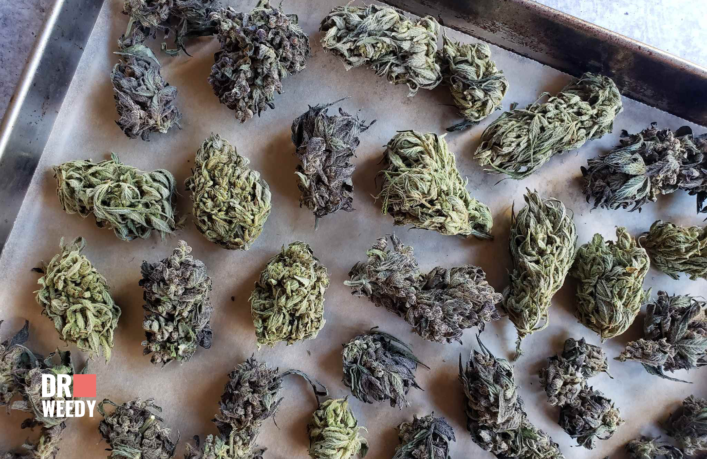
The four common homemade forms are below, plus the cannabinoid medicines a pharmacy fills, which are a separate category altogether.
-
Edibles and capsules
Avoids: smoke, hot vapor and shared mouthpieces.
Still applies: effects can take 30 minutes to 2 hours to start and last longer [4]; THC passes through the liver and can interact with medicines.
-
Infused oil or butter
Avoids: smoke and lung exposure.
Still applies: homemade strength is unknown and uneven, and anything made with it acts like an edible.
-
Tinctures under the tongue
Avoids: smoke and lung exposure. More on how tinctures are used.
Still applies: what gets swallowed acts like an edible; THC effects and drug interactions stay the same.
-
Creams and balms
Avoids: smoke, and for most creams, effects beyond the spot where applied.
Still applies: skin can react to any ingredient; patches made to reach the bloodstream act on the whole body.
-
Prescription cannabinoid medicines
Dronabinol (Marinol, Syndros) and nabilone (Cesamet) are FDA-approved for nausea from chemotherapy, and dronabinol also for appetite loss with weight loss in AIDS; Epidiolex, a purified CBD, is approved for seizures in Lennox-Gastaut and Dravet syndromes [5].
These are prescription drugs filled at a pharmacy, not products bought with a medical card, and the FDA has not approved any other cannabis product on the market [5].
Medical applications
People who use cannabis medically most often describe it as a way to manage symptoms such as chronic pain, poor sleep or nausea, and decarbed cannabis lets them do that without smoke. How well a swallowed form works also depends on absorption: a review of CBD formulations notes that standard oral CBD reaches the bloodstream poorly, with bioavailability under 10%, because the liver breaks much of it down first [6]. That figure comes from a review of pharmaceutical formulations, and it is one reason homemade oral products act so unpredictably.
The original version of this article also suggested anti-inflammatory and anticancer effects. Those claims rest on early lab research, not on evidence that decarbed cannabis treats any disease in people, so they are not repeated here.
Personal care products
Decarbed cannabis is also infused into balms, salves and lotions that are applied to the skin. People use them for a sore spot or stiff joints, and most are meant to act locally rather than throughout the body. Like any skin product, test a small patch first, and keep in mind that these products are not FDA-approved medicines [5].
How to infuse decarbed weed into oil, butter or a tincture, and why strength varies
Infusing works because THC dissolves in fat and alcohol, not in water. That is why decarbed cannabis is steeped in cooking oil, coconut oil or butter over gentle heat, or soaked in high-proof alcohol for a tincture, and then strained. It is also the answer to “decarbed weed in coffee”: stirred into black coffee, very little THC dissolves, and most of it stays in the grounds; a fatty base like milk or butter carries more, but no more evenly.
The weak spot of any homemade infusion is strength. You rarely know the starting THCA content, decarbing at home is partial, some THC stays behind in the strained plant material, and the oil or butter rarely mixes evenly into a batter. Even commercially made edibles are often labeled inaccurately, according to the CDC [4], and homemade ones carry no label at all.
How much decarbed weed should you eat?
This page doesn’t give an amount, and that is deliberate. The THC in a homemade batch is unknown, the same amount affects two people very differently, and medicines you take can change how strongly THC acts. Questions like how much to put in a brownie mix or a stick of butter come down to the same unknowns. The amount and the form are worth working out with a doctor who knows your health and your other medicines; here is how medical cannabis dosing is approached.
Wait before taking more
Edibles can take 30 minutes to 2 hours to act, and their effects can last longer than expected; taking more “because it didn’t work” is how many people end up with cannabis poisoning [4]. If someone feels very unwell, or a child has eaten a cannabis product, call Poison Control at 1-800-222-1222.
Does decarbed weed go bad? How long it keeps
Decarbed cannabis doesn’t spoil quickly, but it does lose strength. Activated THC slowly breaks down into CBN when it meets light, heat and air, so the same batch gets weaker the longer and the worse it is stored. There is no reliable shelf life in months for homemade batches, which is why storage conditions matter more than the calendar.
What are the risks of smoking decarbed weed, and what applies to any form?
The risk depends on how cannabis is taken, not on whether it was decarbed first. Smoking decarbed flower carries the risks of smoke; THC brings its own effects in every form; and shared devices add a third layer that has nothing to do with chemistry.
-
Evaluating physical risks: smoke and hot vapor
A review of the research links regular cannabis smoking to inflamed airways, injury to the windpipe and bronchi, and more respiratory infections [7]; many of those studies could not fully separate cannabis from tobacco use. Cannabis smoke carries many of the same toxins, irritants and carcinogens as tobacco smoke, and smoking it raises the chance of bronchitis, cough and mucus [8].
Burning also creates new compounds. When researchers heated CBD alone in a lab, they detected 86 breakdown products, including aromatic hydrocarbons and phenols [9]; that was a chemical lab study, not a measurement in people. Decarbing in an oven beforehand removes none of this, and vaping drops the flame but still sends a hot aerosol down the same airways.
-
Assessing psychological effects: THC in any form
Whether it is smoked, eaten or held under the tongue, THC can bring anxiety, panic, dizziness and drowsiness. It slows reaction time and coordination, so driving after any form is unsafe [10]. Cannabis use has also been linked to schizophrenia and other psychotic symptoms [10], which is why a personal or family history of psychosis is worth raising with a doctor first. More on cannabis and mental health.
Medicines matter too. CBD can strengthen or weaken other medications, and combining cannabis products with alcohol or other drugs that slow the brain raises the risk of sedation and injury [11]. Sedatives are the clearest example: see why mixing cannabis and Xanax is risky.
-
Shared joints, pipes and vapes
Passing a joint, pipe or vape pen passes saliva along with it, and colds, flu and other infections travel the same way. That risk belongs to the shared mouthpiece, so it applies to raw and decarbed flower alike and disappears with forms nobody puts to their lips.
Balancing benefits and risks
For people who use cannabis to manage symptoms, the useful question is not whether a batch was decarbed but which form, which product and how much fits their health and their other medicines. A form that avoids smoke still carries the effects of THC, and one that acts fast still reaches the lungs. Weighing that is exactly what a medical evaluation is for.
Can cannabis help you quit tobacco?
Not by replacing one smoke with another: cannabis smoke shares many of tobacco smoke’s toxins and carcinogens [8]. Research on cannabinoids for quitting is early. A review of CBD formulations describes a study in which a CBD inhaler cut the number of cigarettes smoked by about 40% [6]; that was purified CBD from an inhaler, not smoked cannabis, and it is reported in a review rather than confirmed in large trials. Proven quit aids exist, and a doctor can help you choose one.
Who should be careful with cannabis, and when to get help
For some people, any form of cannabis needs a doctor’s view before the first use, decarbed or not.
Talk to a doctor first if you
Get help now if, after any form:
- there is chest pain or a racing, pounding heartbeat;
- confusion or panic does not ease;
- vomiting will not stop;
- a child has eaten a cannabis product: children can become very sick from THC [4].
Call 911 in an emergency or Poison Control at 1-800-222-1222.
Using cannabis for a health reason? How a medical evaluation works
Which form to use, and how much, is decided by a doctor who sees your medicines and your health history, not by a recipe. People with long-running conditions such as chronic pain, insomnia or anxiety are among those who ask about medical cannabis, and the evaluation is where their questions about smoke, edibles and interactions get a personal answer.
The appointment is with a physician licensed in your state, one on one, and it all happens online, with nowhere to drive. The doctor decides whether a recommendation is appropriate; the state issues the card.
Across 250 reviews from patients in the states where we are licensed. We do not sort them by score and do not hide the low ones.
- 150,000+patients evaluated — everyone who has been through an appointment with us, in every state where we are licensed
- Since 2017doing only this: online evaluations for medical cannabis programs, and nothing else on the side
Decarbed flower and homemade infusions are still cannabis in the eyes of the law. What forms are allowed, whether you may make edibles at home, and how much you may possess are set by each state and differ widely, and federal rules on marijuana are still shifting rather than settled. Check the state-by-state laws before you make or carry anything.
Frequently asked questions about decarbed weed
Is decarbed weed ready to eat?
Technically yes: the THC in decarbed cannabis is already active, so eating it will have an effect. Dry plant material is unpleasant to eat and absorbs unevenly, which is why it is usually infused into butter or oil first. Like any edible, it acts slowly and lasts long, so the amount is best worked out with a doctor.
Can you put decarbed weed in coffee?
You can, but black coffee carries very little THC, because THC dissolves in fat and alcohol rather than water; most of it stays in the grounds. People who add cannabis to coffee use an infused butter, oil or milk instead. Either way it acts like an edible, slowly, and the strength of a homemade cup is unknown.
Does decarbed weed smell?
Yes. Decarbing releases a strong, toasty smell while it heats, and the kitchen can smell of cannabis for hours. Once cooled, decarbed flower smells fainter and more “cooked” than raw flower, because heat drives off many of the terpenes behind its aroma. A burnt smell means it was overheated.
Does decarbed weed weigh less?
Yes, a little. Heating drives out leftover moisture, and as THCA turns into THC it releases carbon dioxide, so the acid itself loses part of its weight. Drier flower also loses some volatile aroma compounds. How much weight drops depends on how moist the flower was to begin with, so there is no fixed number.
Can you vape decarbed weed?
Yes, a dry-herb vaporizer will heat it, but the vaporizer already decarboxylates raw flower as it works, so decarbing first adds nothing. Decarbed flower is drier and gives off less flavor in a vaporizer. There is no flame, but the hot vapor still reaches the lungs, and shared devices still pass infections along.
Can smoking decarbed weed cause stronger side effects?
Not because it was decarbed: a flame activates THC in raw flower just as fully, so the side effects depend on how much THC you inhale and on you. Anxiety, dizziness or a racing heart can follow any form. The smoke itself is drier and harsher, which can mean more coughing and throat irritation.
Conclusion: what to remember about decarbed weed
Decarbing is a step for cannabis that will be eaten, infused or held under the tongue. For smoking, it changes the flavor and the dryness, not the strength, and it changes nothing about smoke.
Smoke is still smoke
Decarbed or raw, burning flower sends the same toxins and irritants into the lungs.
Decarbing doesn’t add strength
A flame converts THCA on the spot; extra oven heat can only lose some THC.
Form and amount: ask a doctor
THC effects and drug interactions follow every form, so the choice is a medical one.
If you use cannabis for a health reason
Answer a few questions online
It takes about five minutes.
Meet a physician licensed in your state
About fifteen minutes, at a time you agree on with the doctor.
If approved, receive your signed recommendation
It usually arrives within 24–48 hours after the appointment.
Questions before you book? (888) 409-2951 [email protected]
References
13 sources
- 1. Incomplete Decarboxylation of Acidic Cannabinoids in GC-MS Leads to Underestimation of the Total Cannabinoid Content in Cannabis Oils Without Derivatization. DOI: 10.3390/pharmaceutics17030334 PMID: 40142998
- 2. U.S. Department of Agriculture, Agricultural Marketing Service. Establishment of a Domestic Hemp Production Program. 2021.
- 3. CBD, a precursor of THC in e-cigarettes. DOI: 10.1038/s41598-021-88389-z PMID: 33903673
- 4. Centers for Disease Control and Prevention. Cannabis and Poisoning. 2024.
- 5. U.S. Food and Drug Administration. FDA and Cannabis: Research and Drug Approval Process. 2023.
- 6. Cannabidiol: Pharmaceutical formulations and biomedical applications. DOI: 10.22038/ijbms.2026.89134.19592 PMID: 42212209
- 7. Cannabis smoking and respiratory health: consideration of the literature. DOI: 10.1111/resp.12298 PMID: 24831571
- 8. Centers for Disease Control and Prevention. Cannabis and Lung Health. 2024.
- 9. Detection and identification of small-molecule cracking products formed on pyrolysis of cannabidiol part 1: C3 – C10 compounds. DOI: 10.1186/s42238-026-00442-8 PMID: 42067905
- 10. Centers for Disease Control and Prevention. Cannabis Health Effects. 2024.
- 11. U.S. Food and Drug Administration. What You Need to Know (And What We’re Working to Find Out) About Products Containing Cannabis or Cannabis-derived Compounds, Including CBD. 2020.
- 12. Centers for Disease Control and Prevention. Cannabis and Pregnancy. 2025.
- 13. Centers for Disease Control and Prevention. Cannabis and Heart Health. 2024.
This article is for information only and is meant for adults acting within their state’s law. Whether a medical recommendation is appropriate is decided by a doctor at the appointment, and the medical card itself is issued by the state.
This article has misinformation. The link provided in the section describing how marijuana use can “increase the risk of developing mental health conditions such as schizophrenia” states that it can cause early onset in people who would experience those conditions regardless. The phrasing in this article may lead people to believe marijuana will CAUSE schizophrenia, and that is not the case.
Hi Kristen,
Thank you for your feedback on our article. We appreciate your attention to detail. Your comment prompted a review, and we’ve made corrections for clarity. Your contribution helps us ensure accurate and reliable content. Feel free to share more insights.
I’m interested to know why you think it can cause Lung Cancer I was diagnosed with stage 4 lung cancer 4 years ago after a lifetime of smoking bongs daily. I did 2 years of chemo and Imuno therapy. I have been taking tincture that I make daily for over 4 years. My lung cancer has completely disappeared and my oncologist told me there has not been enough studies to reach a definitive conclusion. He also said to keep taking it.
Thank you for sharing your personal experience — we truly appreciate you taking the time to comment. It’s wonderful to hear about your recovery and that cannabis tinctures have been part of your journey.
To clarify, when we mention potential risks such as lung cancer, we refer specifically to smoking cannabis, as inhaling any combusted material (including cannabis or tobacco) can expose the lungs to carcinogenic substances. However, other forms of cannabis use, such as tinctures, edibles, or vaporized products, don’t carry the same risks associated with smoke inhalation.
As your oncologist mentioned, research on cannabis and cancer is still ongoing, and evidence remains limited. We always encourage patients to continue working closely with their medical providers to find the safest and most effective approach for their individual condition.
We’re truly glad you’re doing well, and we wish you continued health and healing. 🌿
Please accept my appreciation for sharing your knowledge. I found it to be the precise area and criteria l need to further understand decarboxylation and its usefulness in my applications.